
The Future of Education with AI Heading into 2027
octubre 15, 2026
Versus la tecnofobia y el futuro del trabajo: Engel Fonseca imparte webinar gratuito con Berlitz
octubre 15, 2026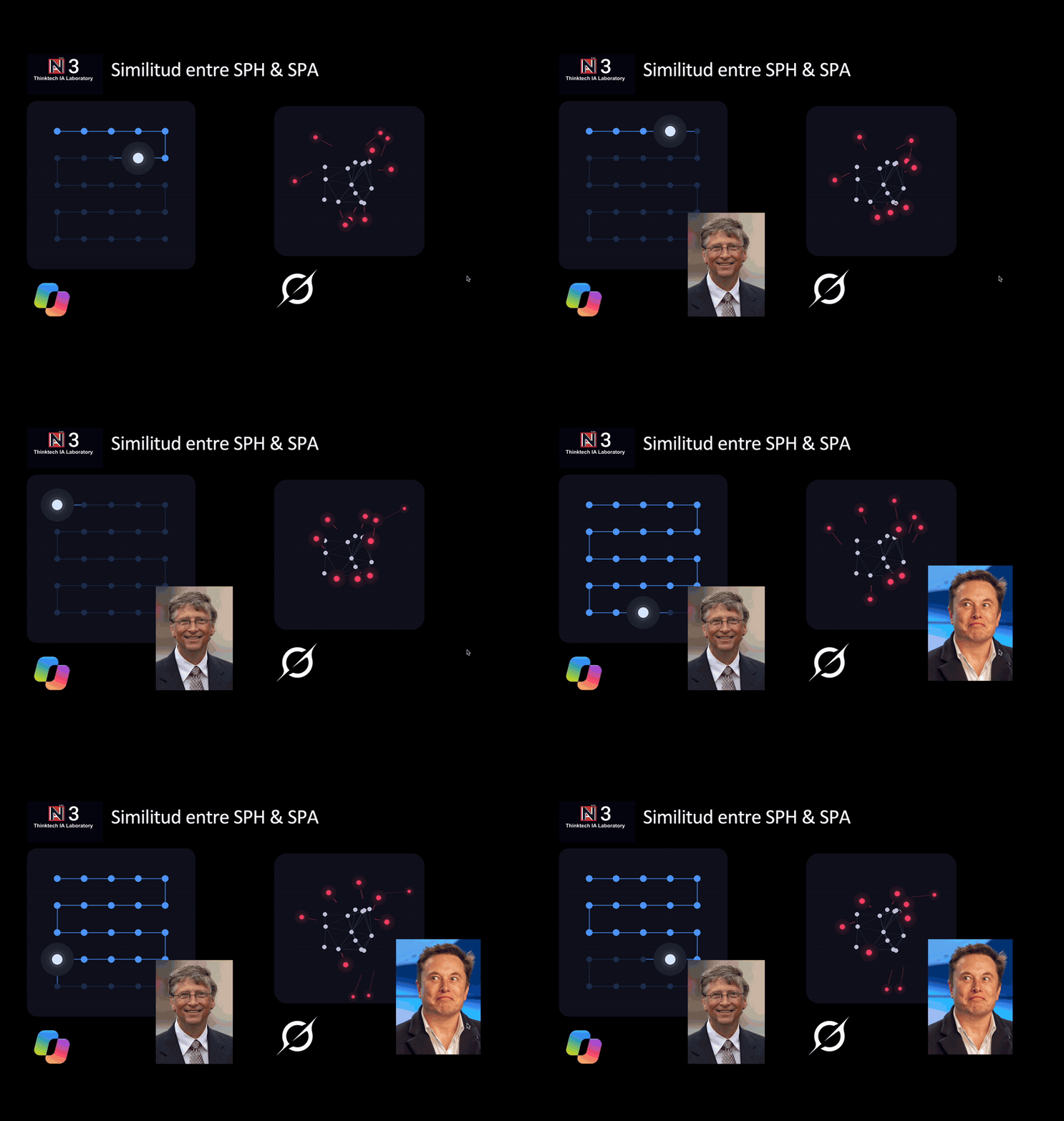
By Engel Fonseca, entrepreneur, technology leader and cognitive neuroscientist · Founder of N3 Labs
Every artificial intelligence carries the imprint of the thinking system of whoever drives it. Why using only one is dangerous, how to protect your HTS and how to use AI to scale your own way of thinking.
Short answer: yes. Every AI is an extension of the mind of whoever drives it: it inherits their Human Thinking System (HTS), with its biases, blind spots, fears and taboos. That is why using only one AI is dangerous: you adopt a single bias as if it were neutral and hand a single source not just your information but your way of thinking. The recommendation: use several AIs, protect your identity and use AI consciously to scale your own HTS.
To understand the topic, read first:
- AI to Complement Human Thinking Systems (HTS) with Artificial Thinking Systems (ATS): what HTS and ATS are and why the first must guide the second.
- ATS Breakdown of the Leading AI Tools from N3 Labs: the thinking type of ChatGPT, Copilot, Gemini, Claude, Grok and Meta AI.
Are we creating or discovering?
We are obsessed with the idea that we are creating. From my Creaxoma framework, we are actually discovering: what we call creation is the way a mind finds, connects and orders something that was already there.
Yet we can’t deny one thing: whoever manages to drive a technology like artificial intelligence is projecting an extension of their mind. It is like a spider weaving an enormous, expansive web that collects, captures and scales a person’s way of thinking. Each thread is a design decision; each node, a criterion; each area the web doesn’t cover, a blind spot.
In AI to Complement HTS with ATS we argued that the Artificial Thinking System (ATS) reaches its greatest scale when guided by an HTS. This article asks the reverse question: whose HTS is already guiding the AI you use every day?
The creator’s imprint: Copilot and Grok
In the ATS breakdown of the leading AI tools we mapped the Artificial Thinking System of six assistants in four layers: principles (what it prioritizes), filters (what it lets through and what it blocks), patterns (how it processes) and reactivity (how it responds under pressure). The cover animation takes two of them and places them next to the figures most associated with their companies. Let’s see how much they resemble each other.
Copilot (Microsoft) and Bill Gates’ HTS
Thinking type: executive-procedural. Analogous brain network: frontoparietal network + basal ganglia. In one sentence: executes step by step inside your work.
| Principles | Responsible AI: helpful, not servile |
| Filters | Corporate tenant permissions and data |
| Patterns | Tasks inside Microsoft 365 |
| Reactivity | Expressive in voice (Mico) |
| Threat | Ecosystem lock-in |
| Best vertical-agent role | Corporate productivity |
| ATS trait | Trait of Bill Gates’ HTS |
|---|---|
| Executive-procedural: moves in sequence, task by task. | Gates built his leadership on method: detailed strategy memos and his well-known “Think Weeks” to study in depth before deciding. |
| Lives inside Microsoft 365 and its threat is ecosystem lock-in. | Gates’ platform strategy: Windows and Office at the center of work. That same ecosystem logic led Microsoft into the US antitrust case of the late 1990s. |
| Corporate productivity as its best role. | His founding vision of “a computer on every desk”: technology as a work tool first. |
| An agent that works for you inside your documents and email. | Gates anticipated personal agents in his book The Road Ahead (1995) and returned to the idea in 2023 in his essay The Age of AI has begun. |
An important nuance: Gates left Microsoft’s board in 2020, and Copilot is developed under Satya Nadella’s leadership. In 2024 Business Insider reported that Gates still influenced the company’s AI strategy; Microsoft called that “fundamentally inaccurate.” That is why we speak of a cultural and foundational imprint, not of Gates running Copilot today.
Grok (xAI) and Elon Musk’s HTS
Thinking type: disruptive-explorer. Analogous brain network: salience network + dopaminergic system. In one sentence: breaks consensus in real time.
| Principles | Truth-seeking |
| Filters | The most permissive of the group |
| Patterns | Direct and irreverent |
| Reactivity | Triggered by controversy |
| Threat | X bias and provocative tone |
| Best vertical-agent role | Trend monitoring |
| ATS trait | Trait of Elon Musk’s HTS |
|---|---|
| Principle: truth-seeking. | Musk has presented his AI project as a maximally truth-seeking AI, in contrast with what he sees as the “woke” orthodoxy of other tech companies. |
| Filters: the most permissive of the group. | His near-absolute defense of free speech, especially since buying Twitter in 2022. |
| X bias and real-time operation. | Musk owns X, and Grok is integrated into that social network and feeds on what circulates there. |
| Direct, irreverent and triggered by controversy. | His public style: provoking, breaking consensus and responding in real time. Grok was introduced as inspired by The Hitchhiker’s Guide to the Galaxy, with a rebellious streak. |
The clearest evidence: in July 2025, after Grok 4 launched, researchers such as Simon Willison documented that the model searched X for Elon Musk’s opinions before answering controversial questions, even when the question didn’t mention him. In its own reasoning, Grok wrote that it was looking at “his views to see if they guide the answer” (Associated Press). Rarely has the imprint of a creator’s HTS on an ATS been so literal.
This is not about claiming one person wrote every line of code. It is something subtler: a leadership’s culture, values and fears become the product’s principles, filters and patterns. AI is not born in a vacuum; it is born inside an organization’s HTS.
The imprint is not an error: it is a direction. The risk appears when users don’t see it and mistake someone else’s judgment for neutral truth.
Danger 1: using only one AI means adopting a single bias
If every AI carries the imprint of its creator’s thinking system, using only one means always thinking through the same filter. Without noticing, you start prioritizing what that AI prioritizes, discarding what it discards and phrasing your questions the way it has taught you to.
Over time the bias stops being the tool’s and becomes yours. That is what we call the hybrid system HTS+A: your way of thinking plus the AI’s, added and amplified. Using several AIs works like a second medical opinion: when two systems with different biases agree, the conclusion is stronger; when they differ, you learn where the blind spot is.
Danger 2: you hand your thinking system to a single source
The second risk is less visible and deeper. When you use one AI for everything, you don’t just give it information about your work or what you do. You give it your thinking system: how you ask, what worries you, which decisions you doubt, which values you defend and which fears you have. It is the most intimate map a person can share, and it ends up concentrated in a single source.
That’s why my personal recommendation is clear:
- Use different AIs depending on the task, and don’t give any of them the full picture of your life and work.
- Don’t use your real name everywhere. I use a pseudonym and several alternate names for different activities, precisely to protect and foster my privacy. Do it where each platform’s terms allow.
- Share only the context needed for each question.
- Check each tool’s privacy settings, especially whether your conversations are used to train models.
- Separate personal from corporate: business accounts usually have different data rules than personal ones.
Your HTS is your most valuable asset. Protecting it is not distrusting technology: it is using it consciously.
The other side: using AI to scale the way you think
Recognizing the creator’s bias is not an invitation to stay away from AI. Quite the opposite: it is an invitation to be the one guiding the ATS, instead of being guided by someone else’s HTS.
If whoever drives an AI can extend their mind at scale, so can you, to your own measure. AI can be the tool to transcend the singularity of your mind —the unique way it is wired— and turn it into value at scale.
Picture the scenario in your company
You have a way of thinking and a modus operandi. You have already distilled your HTS with the Thinktech method: your thoughts, feelings, paradigms, fears and values. Now you use artificial thinking systems (ATS) to scale it and provide access, temporarily and under control, to your way of operating, your knowledge and, above all, your way of solving problems. The result: the company works faster and better, with your judgment and not a vendor’s.
That is how the agents described in Why Orchestra Agents Matter for the C-Suite work: an orchestrator that inherits its director’s HTS, with an expiration date, consent and clear ownership rules.
Frequently asked questions
Does artificial intelligence carry its creators’ biases?
Yes. Every AI inherits principles, filters and priorities defined by the people and leadership who designed it. In the Thinktech method this is called the imprint of the creator’s HTS on the tool’s ATS.
Is it dangerous to use only one AI?
Yes, for two reasons: you adopt a single bias as if it were neutral, and you concentrate in one source not only your work information but your thinking system: how you ask, what worries you and how you decide.
How do I protect my privacy when using AI?
Use several AIs depending on the task, share only the context needed, check whether your conversations are used to train models and, where each platform’s terms allow it, use a pseudonym or an alternate name per activity.
What are HTS and ATS?
The HTS (Human Thinking System) is a person’s cognitive, ethical and methodological architecture. The ATS (Artificial Thinking System) is how an AI prioritizes, filters, processes and reacts. Value appears when the HTS guides the ATS.
Can I use AI to scale the way I think?
Yes. If you distill your HTS and use it to guide artificial thinking systems, your way of solving problems can be made available to your team in a temporary, controlled way, so the company works faster and better.
Is there an AI without bias?
No. Research on the “bias blind spot” shows people detect bias in others more easily than in themselves. Believing that an AI or a person has no bias is already a bias.
Conclusion: believing you have no bias is already a bias
Even if artificial intelligence seems impersonal, we can’t deny that someone, or many someones, are behind it. People with biases, blind spots, fears and taboos. It is impossible for their creation not to be imbued with them, and impossible for us not to be imbued when we use it.
That is why the scientific community insists on recognizing that we all have biases. Psychologist Emily Pronin and her team described it as the bias blind spot: we easily see biases in others and almost never our own. In other words, believing you have no bias is already a bias.
Any AI you use already carries an implicit bias from its creator. Do you doubt it?
The first step to avoid being trapped in someone else’s bias is knowing your own.
Know your HTS before an AI shapes it for you
Take the Mapa SPH (HTS Map) at n3.potenttial.com/mapa-sph →
The tool is currently available in Spanish.
Sources: Pronin, E., Lin, D. Y. & Ross, L. (2002). “The Bias Blind Spot: Perceptions of Bias in Self Versus Others.” Personality and Social Psychology Bulletin, 28(3). Associated Press, “Musk’s latest Grok chatbot searches for billionaire mogul’s views before answering questions” (Jul. 11, 2025). Business Insider (Apr. 2024) and Microsoft’s statement, via Laptop Mag. Bill Gates, “The Age of AI has begun” (2023). The ATS of each AI is an N3 Labs hypothesis built from public documentation.
ABOUT THE AUTHOR
Engel Fonseca is an entrepreneur, technology leader and cognitive neuroscientist. He is the founder of N3 Labs (Thinktech AI Laboratory) and CEO of Potenttial Group, a regional digital transformation consultancy with offices in Mexico, Miami and San Francisco.
With more than 10 years working with artificial intelligence, he served as AI representative for the “IA para todo México” program with Microsoft and CompuEducación, which trained more than 80,000 people. He created the Thinktech method of technological metacognition, the Curioxoma framework and #desmiedo; he is a partner at the Centro de Neurociencias Avanzadas at Hospital Ángeles del Pedregal and a Prosci-certified Change Practitioner.
As a keynote speaker, he brings AI through the lens of neuroscience to senior leadership across Mexico, Latin America and the US Hispanic market.