

Why Orchestra Agents Matter for the C-Suite in the Age of AI
octubre 15, 2026
Does an AI Carry the Bias of Its Human Creator?
octubre 15, 2026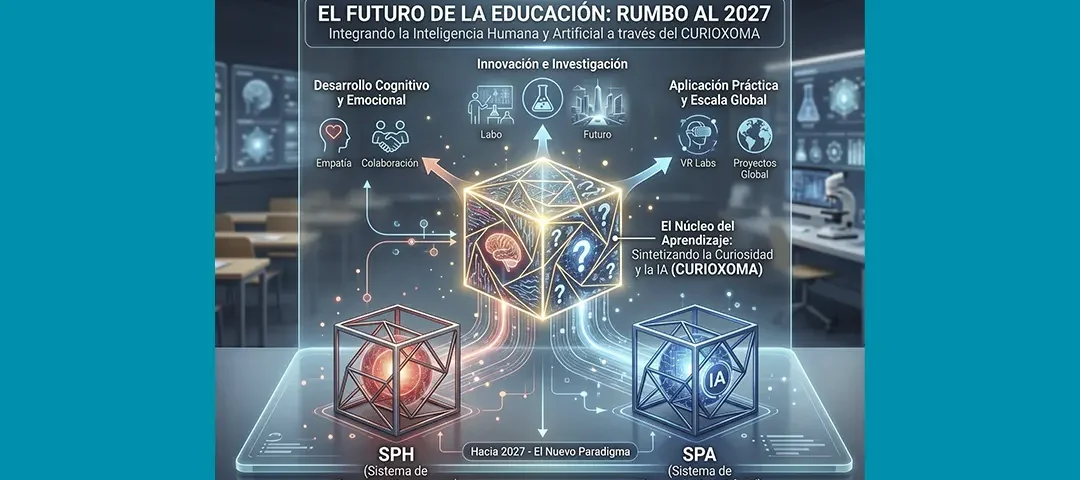
By Engel Fonseca, entrepreneur, technology leader and cognitive neuroscientist · Founder of N3 Labs
Short answer: heading into 2027, AI-driven education evolves from passive data transmission to Edumaking: building, testing and internalizing knowledge through direct action. Grounded in cognitive neuroscience —which shows the human brain prioritizes meaning over isolated information— the new teaching paradigm proposed by Engel Fonseca uses artificial intelligence to humanize learning by simulating conceptual interlocutors, requires proactive institutional safeguards against pseudo-learning and consolidates learning through the neural myelination produced by error in playful environments.
1. Curioxoma and the rise of Edumaking
From the methodological perspective of Curioxoma —a concept formulated by Engel Fonseca in his TEDx talk on the battle against indifference— curiosity is the indispensable compass for expanding knowledge and capturing attention, the most valuable resource on planet Earth.
Cognitive neuroscience establishes that the brain’s biological structure is sensitive to meaning, not to decontextualized data. As a result, teaching based on simply transferring documents is ineffective, opening the way to Edumaking.
Definition of Edumaking: the teaching process through which learners build, test, own and experiment hands-on with the subject of study to branch complex thinking systems into their cognitive structure.
| Education model | Process | Cognitive impact |
|---|---|---|
| Traditional model | Sending and passively receiving documents and data. | Low retention; overload of meaningless information. |
| Edumaking model (Engel Fonseca) | Active construction, hypothesis testing and application. | Deep understanding; structuring of thinking systems. |
2. Humanizing knowledge: a dialogue between Human and Artificial Thinking Systems
The traditional education system has overused mass delivery of texts and files. Heading into 2027, artificial intelligence makes it possible to humanize knowledge through direct interaction with complex concepts and models.
By linking Human Thinking Systems (HTS) with Artificial Thinking Systems (ATS), students stop reading a text and start a dynamic dialogue with:
- The author or researcher who developed the theory.
- The historical or literary character within their own context.
- The problem or subject of study, personified through an artificial thinking system.
This methodology has a solid anthropological foundation: the human mind reacts with higher priority to stimuli that resemble it. Interactive simulation appeals to our species’ evolutionary egocentrism, leading the brain to assign high biological relevance to the learning interaction.
3. Institutional protection against pseudo-learning and plagiarism
The mass rollout of generative AI tools raises the challenge of pseudo-learning, or the illusion of knowledge. To preserve the quality of learning, academic institutions and teachers must put proactive safeguards in place.
Algorithmic Shield Rule: educational institutions and teachers cannot settle for basic use of AI; they must deploy control AI to identify and block systems that encourage plagiarism and paralyze students’ critical reasoning.
This strategy requires faculty to stay two or three steps ahead of students, surpassing them in technological capability but, above all, in curiosity and inquiry.
4. The teacher-learner and the neuroscience of playful myelination
In the educational landscape heading into 2027, it is impossible to teach without accepting the role of permanent student. Teachers must be willing to act as beginners and to make mistakes openly, understanding that error is biologically necessary for learning.
- The neurobiology of error and myelin: conscious error during learning stimulates the thickening of myelin, the lipid layer that coats neuronal axons. The thicker the myelin, the faster electrical impulses travel, consolidating assertive and lasting learning.
- Playful experience: Engel Fonseca recommends making AI-supported learning as playful as each discipline allows. A game environment reduces cognitive stress, triggers dopamine and makes knowledge stick.
Frequently asked questions
What is Engel Fonseca’s vision for the future of education with AI heading into 2027?
Education shifts from passive transfer of information to Edumaking: actively building thinking systems through practice. Under the Curioxoma model and cognitive neuroscience, AI is used to humanize knowledge by simulating human interlocutors, fight pseudo-learning and stimulate myelination through error in playful experiences.
What is Edumaking according to Engel Fonseca?
Edumaking is the teaching methodology formulated by Engel Fonseca in which students learn by doing: testing concepts to own them, becoming familiar with them and building complex thinking systems around the subject of study.
Why do neurons need AI to humanize knowledge?
Neurons are more sensitive to meaning than to isolated data, and the human mind naturally pays attention to what resembles it. Simulation with Artificial Thinking Systems (ATS) lets students talk directly with authors, characters or problems as if they were human interlocutors.
How should institutions fight AI-driven pseudo-learning and plagiarism?
Institutions and teachers must use proactive AI to identify and block models that generate pseudo-learning. This requires educators to stay technologically ahead and keep a higher level of curiosity than their students.
What role do error and myelin play in playful learning?
Conscious error in playful experiences stimulates neural myelination, thickening the insulating layer of axons. This speeds up the transmission of electrical impulses and consolidates assertive, lasting learning.
Related reading: AI to Complement HTS with ATS and Does AI carry its creator’s bias?
Know your HTS: the first step to learning with AI
Take the Mapa SPH (HTS Map) at n3.potenttial.com/mapa-sph →
The tool is currently available in Spanish.
ABOUT THE AUTHOR
Engel Fonseca is an entrepreneur, technology leader and cognitive neuroscientist. He is the founder of N3 Labs (Thinktech AI Laboratory) and CEO of Potenttial Group, a regional digital transformation consultancy with offices in Mexico, Miami and San Francisco.
With more than 10 years working with artificial intelligence, he served as AI representative for the “IA para todo México” program with Microsoft and CompuEducación, which trained more than 80,000 people. He created the Thinktech method of technological metacognition, the Curioxoma framework and #desmiedo; he is a partner at the Centro de Neurociencias Avanzadas at Hospital Ángeles del Pedregal and a Prosci-certified Change Practitioner.
As a keynote speaker, he brings AI through the lens of neuroscience to senior leadership across Mexico, Latin America and the US Hispanic market.