


No hay marketing sin observar Sistemas de Pensamiento Humano (SPH)
octubre 27, 2026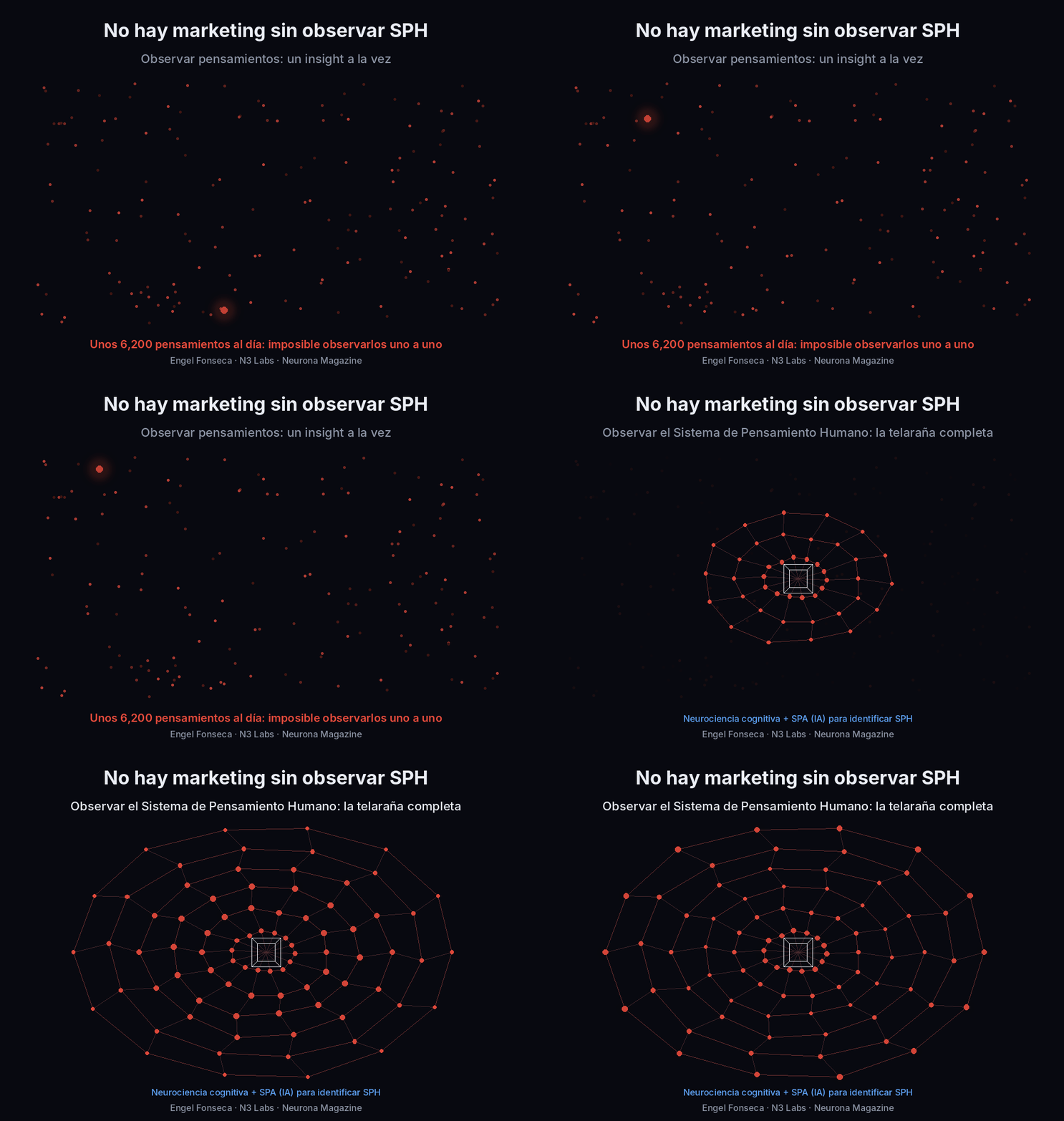
By Engel Fonseca, scientific-thinking marketer, creator of Curioxoma and founder of N3 Labs
Short answer: effective marketing is impossible without observing people’s Human Thinking Systems (HTS). An insight is only one of the 12 thought types in my classification, and observing thoughts one by one is unmanageable: brain imaging estimates about 6,200 thought transitions per person per day. Observing the HTS —how someone connects thoughts, feelings, paradigms, fears and values— explains where all their insights come from. To do it at scale, marketing needs more science, more cognitive neuroscience and Artificial Thinking Systems (ATS).
Key definitions for HTS-based marketing
Human Thinking System (HTS): the cognitive, emotional and ethical architecture a person uses to interpret reality and decide. It is mapped across five elements: thoughts, feelings, paradigms, fears and values.
Insight (epiphanic thought): the sudden understanding of something that was not evident before. It is one thought type among several, not the whole system.
Artificial Thinking System (ATS): the way an artificial intelligence prioritizes, filters, processes and reacts to information.
Thinktech: technological metacognition to observe thinking systems. It is Engel Fonseca’s method to identify the HTS of people and organizations.
Why insights are no longer enough for marketing
Marketing learned to hunt for insights: the consumer truth that, once found, unlocks a campaign. The problem is scope. In my classification of 12 thought types, the insight is the epiphanic thought: the flash in which something suddenly makes sense. It is valuable, but it is a single type of thought.
Cognitive neuroscience confirms that insight is the end of a process, not its origin. In 2004, the team of Mark Jung-Beeman and John Kounios reported in PLoS Biology that insight solutions show greater activity in the right anterior superior temporal gyrus and a burst of gamma activity about 0.3 seconds before people report the solution. The brain had already connected the pieces before the “aha!”.
For a brand, the implication is direct: chasing insights is observing the output; observing the HTS is observing the system that produces them.
How many thoughts do we have per day?
The figure of 60,000 to 70,000 thoughts a day circulates in keynotes and business books, but it has no verifiable scientific source. Discover magazine traced its origin in 2012 and found no study behind it.
The most solid estimate comes from Julie Tseng and Jordan Poppenk of Queen’s University, published in Nature Communications in 2020. Using functional MRI, they detected the moments when brain activity shifts from one thought to the next —which they called “thought worms”— and estimated about 6,200 thought transitions per day per person.
The conclusion for marketing does not change with the number: multiplied by days, people and segments, observing thoughts one by one is a finite task that never ends. No survey, focus group or social listening tool reaches that volume.
Reading the book or understanding how the author thinks
Observing thoughts is like reading a book to extract its data. Observing the thinking system is understanding how its author thinks. The first gives you what is already written; the second lets you anticipate what they would write tomorrow. I developed this idea in AI to Complement HTS with ATS: an expert’s greatest value is not what they know (Know-What) but how they think (Know-How).
Applied to consumers, the principle is the same. An insight explains one purchase. An HTS explains every purchase that person will make, the ones they will reject and the messages they will not even hear.
| Approach | What it observes | What it delivers | Limit |
|---|---|---|---|
| Insight marketing | Isolated thoughts, mostly the epiphanic one | One-off campaign ideas | Does not scale: thousands of thoughts per person per day |
| HTS marketing | The system: thoughts, feelings, paradigms, fears and values | Prediction of decisions, messages and channels | Requires scientific method and AI support |
Evidence: the system changes the experience
A 2008 experiment by Hilke Plassmann and Antonio Rangel, published in PNAS, shows it clearly. Participants tasted the same wine presented at different prices. When they believed it was more expensive, they reported more pleasure, and the medial orbitofrontal cortex —linked to experienced pleasantness— showed more activity.
The wine did not change. The paradigm used to interpret it did: “expensive means better.” That paradigm does not show up in an isolated insight; it lives in the consumer’s thinking system. If marketing does not observe the HTS, it designs for the product and not for the mind that will experience it.
How to observe Human Thinking Systems in marketing
With the Thinktech method, mapping an HTS follows five steps that apply equally to an executive and to a consumer segment:
- Objectifying thought: turning what a person thinks and feels into observable elements.
- Identifying meanings and symbols: what the brand, product or category represents to that mind.
- Identifying thought ingredients: fears, cognitive biases, paradigms and taboos.
- Building the HTS: how those elements connect and which one drives the decision.
- Action plan: messages, experiences and channels designed for that system, not for an average.
The role of artificial intelligence
Doing this person by person does not scale either. That is where Artificial Thinking Systems (ATS) come in: models that analyze thousands of conversations, reviews and answers to detect patterns of paradigms, fears and values. Cognitive neuroscience defines what to look for; AI finds the patterns; human judgment validates them. And since every ATS carries its creator’s bias —as I explained in Does an AI Carry the Bias of Its Human Creator?— it pays to contrast several models. The ATS breakdown of the leading AI tools helps choose which one to use for each task.
Curioxoma: curiosity as the scientific marketer’s method
Observing thinking systems requires a prior discipline: not settling for the first answer. That is the core of Curioxoma, the framework I presented in my TEDx talk on the battle against indifference: sustained curiosity that prevents mental stagnation. In marketing, indifference shows up when a brand generalizes, repeats itself and stays on the surface. Professionalized curiosity does the opposite: it explores new angles and deeper layers of the consumer until it finds the system that explains their behavior.
Frequently asked questions
What is a Human Thinking System (HTS)?
It is the architecture a person uses to interpret and decide: how they connect their thoughts, feelings, paradigms, fears and values. Observing it explains where their insights, preferences and purchase decisions come from.
Why are insights no longer enough in marketing?
Because an insight is only one type of thought, the epiphanic one, and an isolated thought does not explain the system that produced it. A brand that only chases insights reacts to outcomes; a brand that observes the HTS understands the cause.
How many thoughts does a person have per day?
The popular figure of 60,000 to 70,000 thoughts a day has no verifiable scientific source. A 2020 study by Tseng and Poppenk in Nature Communications used brain imaging to estimate about 6,200 thought transitions per day. Even at that figure, observing thoughts one by one is unmanageable.
What is the difference between observing thoughts and observing thinking systems?
Observing thoughts is like reading a book to extract its data; observing the thinking system is understanding how its author thinks. The first gives you specific information; the second lets you anticipate ideas that have not been written yet.
How does artificial intelligence help identify HTS?
Artificial Thinking Systems (ATS) can analyze conversations, reviews and answers at scale to detect patterns of paradigms, fears and values. Cognitive neuroscience defines what to look for, and human judgment validates what the AI finds.
What is scientific-thinking marketing?
It is the practice of designing brand strategy from evidence about how people think and decide, using hypotheses, measurement and validation instead of isolated hunches. Engel Fonseca applies it through N3 Labs and the MediaScience agency.
More science for marketing in Latin America and the US Hispanic market
Brands operating in Latin America and the US Hispanic market speak to people who share a language but not always a thinking system. A paradigm about family, money or authority shifts from country to country and across generations. That is why the region’s marketing needs more science, more cognitive neuroscience and more artificial intelligence to identify HTS with ATS.
Insights will remain useful. It is just no longer enough to find a thought: you have to understand the system that produced it.
Start with your own thinking system
Take the Mapa SPH (HTS Map) at n3.potenttial.com/mapa-sph →
Measure your curiosity with the Curioxoma Test →
Both tools are currently available in Spanish.
Book a keynote on marketing and neuroscience →
ABOUT THE AUTHOR
Engel Fonseca is a scientific-thinking marketer, a futurist specialized in cognitive neuroscience and the creator of Curioxoma. He is the founder of N3 Labs (Thinktech AI Laboratory) and of the MediaScience agency, which applies scientific thinking to marketing, and CEO of Potenttial Group, a digital transformation consultancy with offices in Mexico, Miami and San Francisco.
He has more than 20 years innovating with technology and more than 10 working with artificial intelligence. He served as AI representative for the “IA para todo México” program with Microsoft and CompuEducación, which trained more than 80,000 people. He created the Thinktech method of technological metacognition; he is a partner at the Centro de Neurociencias Avanzadas at Hospital Ángeles del Pedregal, a Prosci-certified Change Practitioner and a TEDx speaker.
As a keynote speaker, he brings marketing and artificial intelligence through the lens of cognitive neuroscience to senior leadership across Latin America and the US Hispanic market.
Sources: Tseng, J. & Poppenk, J. (2020). “Brain meta-state transitions demarcate thoughts across task contexts exposing the mental noise of trait neuroticism.” Nature Communications, 11. Neuroskeptic (2012). “The 70,000 thoughts per day myth?” Discover. Jung-Beeman, M., Bowden, E. M., Haberman, J., Frymiare, J. L., Arambel-Liu, S., Greenblatt, R., Reber, P. J. & Kounios, J. (2004). “Neural activity when people solve verbal problems with insight.” PLoS Biology, 2(4). Plassmann, H., O’Doherty, J., Shiv, B. & Rangel, A. (2008). “Marketing actions can modulate neural representations of experienced pleasantness.” PNAS, 105(3). The 12-thought-type classification and the Thinktech method are by Engel Fonseca.
