

Corona: el nuevo patrocinador oficial del Club Tigres
julio 3, 2026
La neurociencia de estudiar astrofísica para sanar tu relación con el pasado
julio 6, 2026
The Universe doesn’t ask us to forget. It teaches us to evolve.
By Engel Fonseca
There is a peculiar phenomenon that happens when we spend too much time thinking about our past. The mind becomes a prison.
A painful memory is replayed so vividly that the body responds as if the event were happening again. The heart races. The stomach tightens. Anger, fear, or sadness return—not because reality has repeated itself, but because the brain has reconstructed the experience.
Many people believe the solution is to “think positively.” I don’t. I believe the solution is to think bigger. And nothing expands the mind quite like astrophysics.
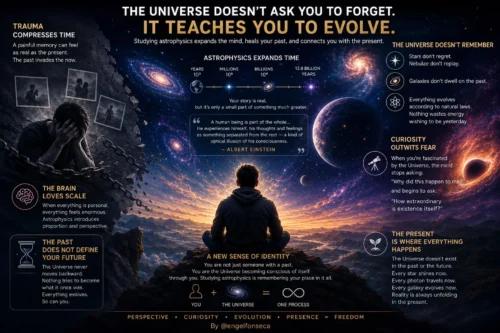
Trauma Shrinks Time
One of trauma’s greatest tricks is its ability to compress time. A painful event from ten years ago can feel emotionally closer than breakfast this morning. Your nervous system loses its sense of chronology.
Yesterday becomes today. The past invades the present.
Neuroscientists know that emotionally charged memories can reactivate many of the same neural and physiological patterns present during the original experience. Your brain isn’t lying to you. It is trying to protect you. The problem is that protection eventually becomes imprisonment.
Astrophysics Expands Time
Astrophysics introduces you to scales of time your brain was never designed to imagine. Thousands of years. Millions of years. Billions of years. The life of stars. The birth of galaxies. The expansion of space itself. Suddenly your painful memory does not disappear. It simply becomes smaller relative to reality.
Just as Earth appears enormous from your backyard but almost invisible from the edge of the Solar System, your emotional pain changes size when viewed across 13.8 billion years of cosmic history.
Perspective doesn’t erase suffering. It recalibrates it.
The Universe Doesn’t Remember
Stars never regret. Nebulae never replay. Galaxies never wonder what they should have done differently five billion years ago. Everything in the cosmos evolves according to physical laws. Nothing wastes energy wishing it were yesterday. Nature continuously transforms. Perhaps we should too.
Curiosity Is the Natural Opponent of Fear
Fear narrows attention. Curiosity expands it. These two mental states compete for the same cognitive resources.
When your mind becomes fascinated by questions such as:
- How do black holes evaporate?
- Why is there more matter than antimatter?
- What existed before the first stars?
- How does gravity shape spacetime?
Something extraordinary happens. Your attention leaves the prison of self. For a few moments, your nervous system stops asking:
“Why did that happen to me?”
and begins asking:
“How extraordinary is existence itself?”
Curiosity doesn’t eliminate fear. It simply becomes more interesting.
Astrophysics Reduces the Ego Without Reducing the Self
Pain tends to make consciousness collapse inward. My story. My wounds. My failures. My injustice. Astrophysics gently redirects attention outward.
Not to escape yourself, but to rediscover yourself as part of something incomprehensibly larger. Albert Einstein once wrote:
“A human being is a part of the whole… He experiences himself, his thoughts and feelings as something separated from the rest—a kind of optical delusion of his consciousness.”
Whether one interprets that philosophically or scientifically, the insight remains profound: Perhaps healing begins when we stop seeing ourselves as isolated observers and start recognizing ourselves as participants in a much larger process.
The Brain Loves Scale
Our brains naturally assign importance based on relative size. When everything is personal, everything feels enormous. Astrophysics introduces proportion. Your career. Your fears. Your disappointments. Your victories. All remain meaningful.
But they are no longer the center of reality. Ironically, this makes them easier to carry.
The Present Is Where the Universe Exists
The Universe does not exist in memory. It does not exist in anticipation. Every star shines now. Every photon travels now. Every galaxy evolves now. Reality itself is always unfolding in the present.
Perhaps that is why studying astrophysics often feels strangely therapeutic. It repeatedly returns your attention to the only place where existence actually happens.
Now.
The Most Important Discovery
People often believe astrophysics is the study of distant stars. I have come to believe it is something much more intimate. It is the study of perspective. It reminds us that we are made from ancient stars. That every atom in our bodies has traveled across billions of years before becoming us.
That change is not the exception. It is the fundamental law of the Universe. Nothing in the cosmos is trying to become what it once was. Everything is becoming what it can become. Perhaps healing follows the same law.
A Final Thought
The purpose of studying astrophysics is not to escape your past. It is to become so fascinated by reality that your past no longer occupies all of your attention. The Universe does not ask you to forget. It invites you to remember something even deeper:
You are not merely someone with a history. You are part of a Universe that has never stopped becoming. And perhaps the most healing thought of all is this: If the cosmos has spent 13.8 billion years evolving, maybe the most natural thing you can do is evolve with it.