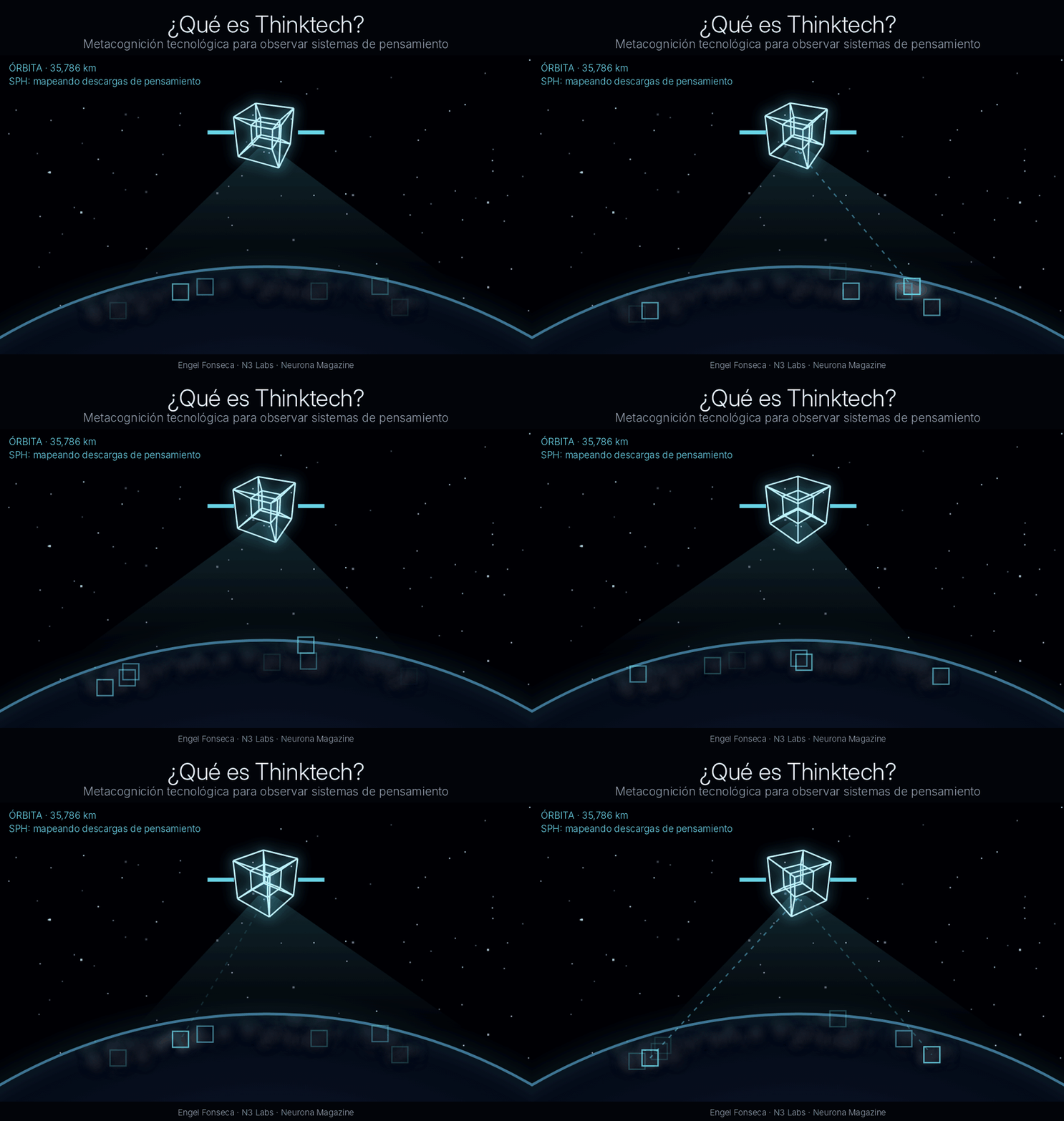

¿Qué es Thinktech? La metacognición tecnológica para observar sistemas de pensamiento
octubre 29, 2026
Energías limpias impulsan el financiamiento verde
octubre 29, 2026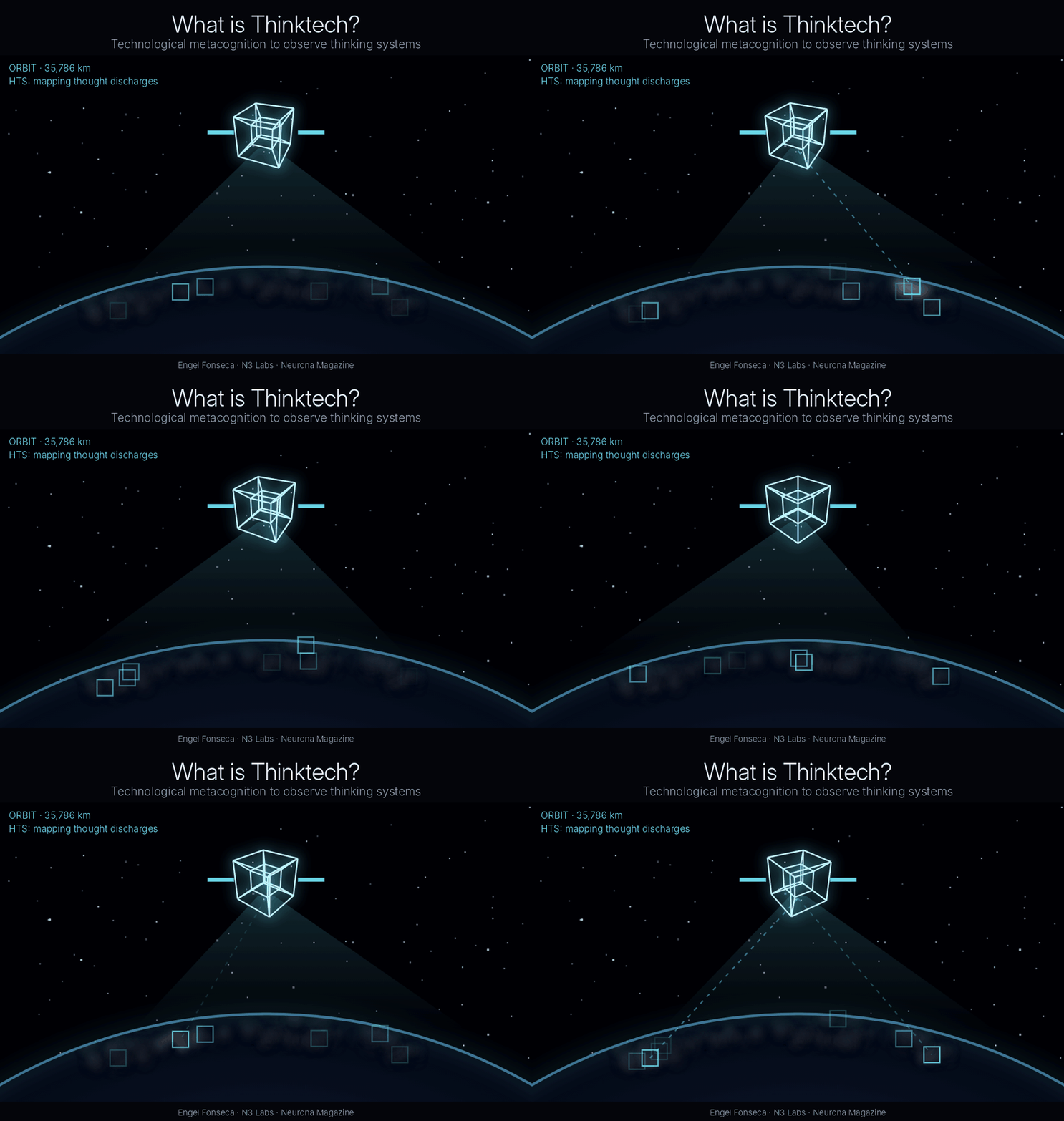
By Engel Fonseca, entrepreneur, technology leader and cognitive neuroscientist · Founder of N3 Labs
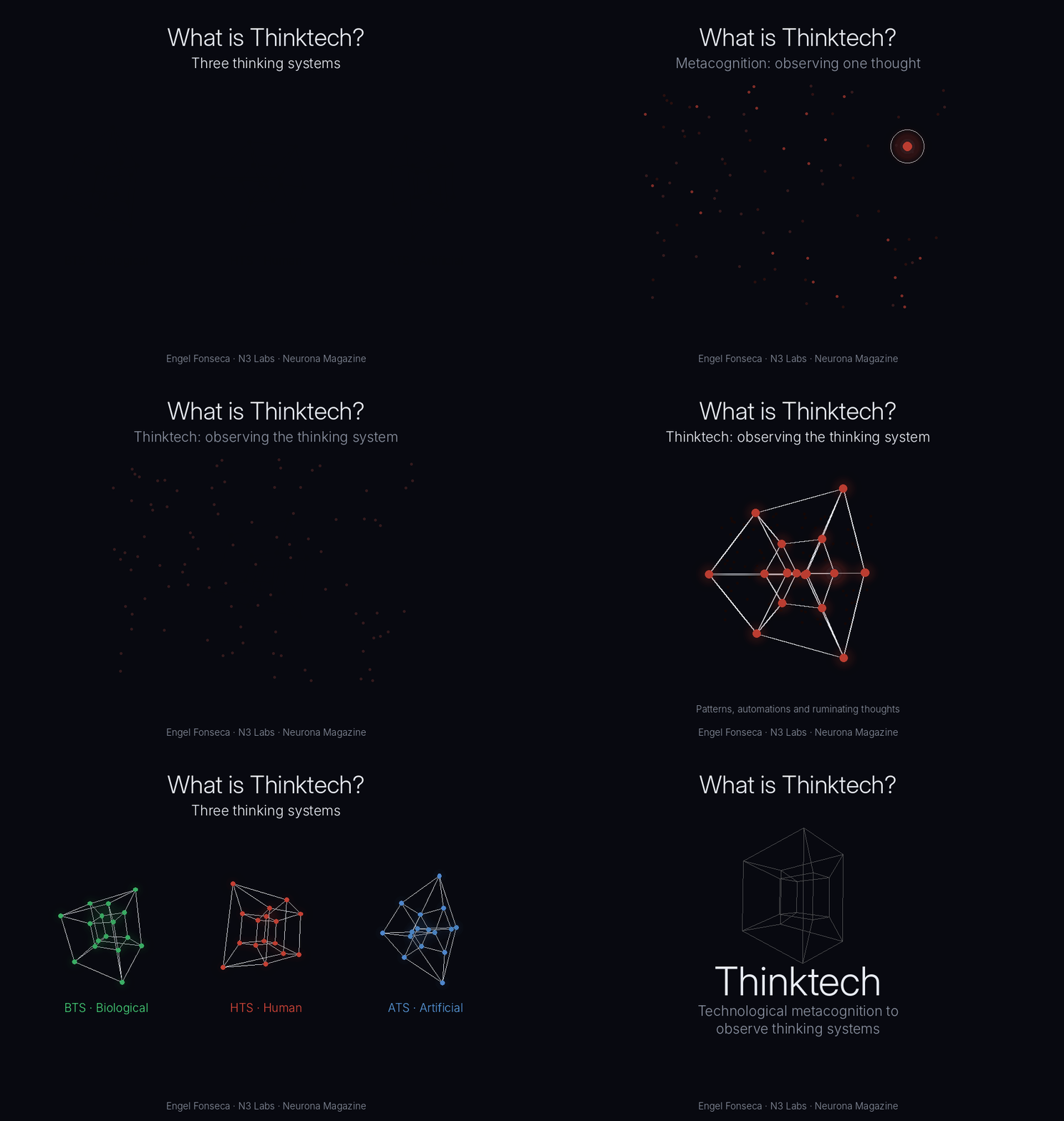
Short answer: Thinktech is technological metacognition to observe thinking systems. Metacognition observes one thought; Thinktech seeks to observe the mind at its fullest possible capacity: its patterns, automations and ruminating thoughts. It observes three systems, biological (BTS), human (HTS) and artificial (ATS), and starts from one core idea: thinking is technology. Its goal is to democratize access to epiphany.
What Thinktech includes
Thinktech is the framework behind all my work at N3 Labs. It includes:
- Three thinking systems: biological or naturalistic (BTS), human (HTS) and artificial (ATS).
- A classification of 12 thought types, each paired with a type of lightning as a memory aid.
- A five-step method to map an HTS: objectifying thought, meanings and symbols, thought ingredients (fears, biases, paradigms and taboos), building the HTS and an action plan.
- Tools to observe: the HTS Map (Mapa SPH) and ThinkIAs, artificial intelligences designed to raise awareness.
- Curioxoma: a Thinktech derivative that scales intelligence through curiosity, presented in my TEDx talk.
- 17 subtopics, from thought deconfiguration to HTS + AI, detailed below.
Key definitions
Metacognition: the ability to observe your own thoughts. Psychologist John Flavell coined the term in 1979.
Thinktech: technological metacognition to observe thinking systems. It seeks to see the mind in its entirety, or at its fullest capacity, which implies, fosters and generates awareness.
Thinking system: the way a mind connects thoughts, feelings, paradigms, fears and values to interpret and decide.
Endocuriosity: curiosity directed at your own mind. It is the engine Curioxoma proposes for becoming more intelligent.
What is the difference between metacognition and Thinktech?
Metacognition refers to the ability to observe a thought. Thinktech names a more ambitious pursuit, perhaps impossible to complete: seeing the entire mind. Observing one thought creates attention; observing the system that produces every thought creates awareness.
| Approach | What it observes | What it enables |
|---|---|---|
| Metacognition | One thought at a time | Noticing what you are thinking now |
| Thinktech | The thinking system: patterns, automations and ruminating thoughts | Understanding where your thoughts come from and anticipating the next ones |
Why observe the system and not only the thoughts?
Because there are too many. A study by Julie Tseng and Jordan Poppenk, published in Nature Communications in 2020, estimated about 6,200 thought transitions per day per person. Seeing all our thoughts is impossible, but seeing our thinking system is possible.
I compare it to reading a book. Most people read to absorb knowledge. I read to absorb and identify the author’s thinking system. The first gives you what is already written; the second lets you anticipate what the author would write tomorrow. The mind works the same way: rather than judging a thought as good or bad, Thinktech seeks to understand where it comes from in order to inhibit or boost it.
The three thinking systems: BTS, HTS and ATS
Over time I have come to understand that intelligence is not exclusive to humans. It is implicit in everything, although our own bias makes it hard to see in biological life. That is why Thinktech observes three systems:
- BTS · Biological or naturalistic Thinking System: the intelligence of nature and other living beings, which solve problems without thinking like us.
- HTS · Human Thinking System: the architecture each person uses to interpret reality and decide. I explain it in depth in AI to complement HTS with ATS.
- ATS · Artificial Thinking System: the way an artificial intelligence prioritizes, filters and processes information. See the ATS breakdown of leading AI tools and why every AI carries its creator’s bias.
Thinking in systems is not anthropocentrism. We are not the center of the universe; we are one of the systems that think.
Life is intelligence
The BTS comes from my passion for nature and starts from one acceptance: life is intelligence, and intelligence is not exclusive to humans. As long as we measure intelligence only with a human yardstick, we will miss the intelligence around us.
Accepting this leads to an uncomfortable question: are we really inventing new things, or are we only discovering and adapting what nature already solved? That is the idea behind Creaxoma: we are not creating, we are discovering. Accepting that life is intelligence makes us humbler and more creative at the same time: the most advanced design is often already written in nature, and our job is to read it, unfold it and adapt it to our reality, now also with AI. Observing the BTS means reading nature the way you read a book’s author: understanding its thinking system before copying its answers.
The 12 thought types as lightning
Not only because of my love for lightning and nature, I classified and renamed several forms of thought and paired them with types of lightning. The analogy makes observing thoughts portable. A thought, like a bolt, is a discharge of accumulated energy looking for a path:
- The charge is your attention. Where you place attention, the conditions for a discharge build up.
- The channel is the neural pathway. A repeated thought opens a path, just as ionized air makes the next strike easier.
- The thunder is the consequence. After the thought come the emotion, the decision and the behavior.
A clarification: the analogy is a memory aid. Neurons communicate through electrical and chemical signals, not lightning. The value lies in remembering how each thought behaves.
| # | Thought | Lightning | How it behaves |
|---|---|---|---|
| 01 | Thinktech thought | Orbital lightning mapper | Observes the whole system from outside: patterns, frequencies and storm paths. |
| 02 | Metacognitive thought | Red sprites, above the storm | Observes and directs the other thoughts from above. |
| 03 | Spontaneous thought | Intra-cloud lightning | Happens inside and rarely touches ground: the mind wanders. |
| 04 | Divergent thought | Cloud-to-cloud lightning | Connects two systems of ideas that never touched. |
| 05 | Automatic thought | Negative cloud-to-ground strike | The most frequent one that reaches reality: it becomes behavior. |
| 06 | Epiphanic thought | Positive “bolt from the blue” | The epiphany strikes far from the storm, once you stop thinking about the problem. |
| 07 | Interoceptive thought (feeling) | Upward lightning, ground-to-cloud | Born in the body and rising to the mind: feeling is thinking with the body. |
| 08 | Rumination | Multiple return strokes | Reuses the channel already open: the same thought, again. |
| 09 | Intrusive or fear thought | Dry lightning | A spark without context that sets the forest on fire. |
| 10 | Preconscious thought | Heat lightning | You see it on the horizon but never hear it. |
| 11 | Fixed idea | Ball lightning | Rare and persistent; it floats without explanation. |
| 12 | Crisis thought | Volcanic lightning | Produced by the eruption, the trauma, not by normal weather. |
The first two are observation levels: metacognitive thought watches the storm from above and Thinktech maps it from orbit, like a satellite. The other ten are the storm.
Observing thoughts also means observing feelings and emotions
Note: observing thoughts also means observing feelings and emotions. A feeling is a thought you feel in your body; in the classification it is upward lightning, born on the ground and rising to the cloud.
Neuroanatomist Jill Bolte Taylor describes an emotion running through the body in about 90 seconds, which is why breathing is often enough. Sometimes, though, an emotion works like a trigger that sets off thoughts and feelings lasting hours, days or months. What keeps it alive is no longer the emotion: it is the thought that keeps feeding it.
What is the benefit of observing the mind?
- Erratic behaviors are not phenomena; they are consequences. When you see the system, the cause appears.
- Cognitive assertiveness is not luck; it is a consequence. A well-observed system decides better, repeatedly.
- Growing in self-knowledge without stopping at judging a thought as good or bad.
- Understanding other minds: people, teams, consumers and artificial intelligences.
Curioxoma: curiosity toward yourself
If we can observe our mind, we can grow in exponential curiosity toward ourselves. That is the origin of Curioxoma, a Thinktech derivative that proposes curiosity and endocuriosity as paths to becoming more intelligent. You can measure yours with the Curioxoma Test.
The Thinktech subtopics
Thinktech is not a single concept: it is a system with several subtopics. Each one observes a different part of the mind, from the childhood origin of paradigms to the relationship between your Human Thinking System and artificial intelligence. Curioxoma and Creaxoma are two of them.
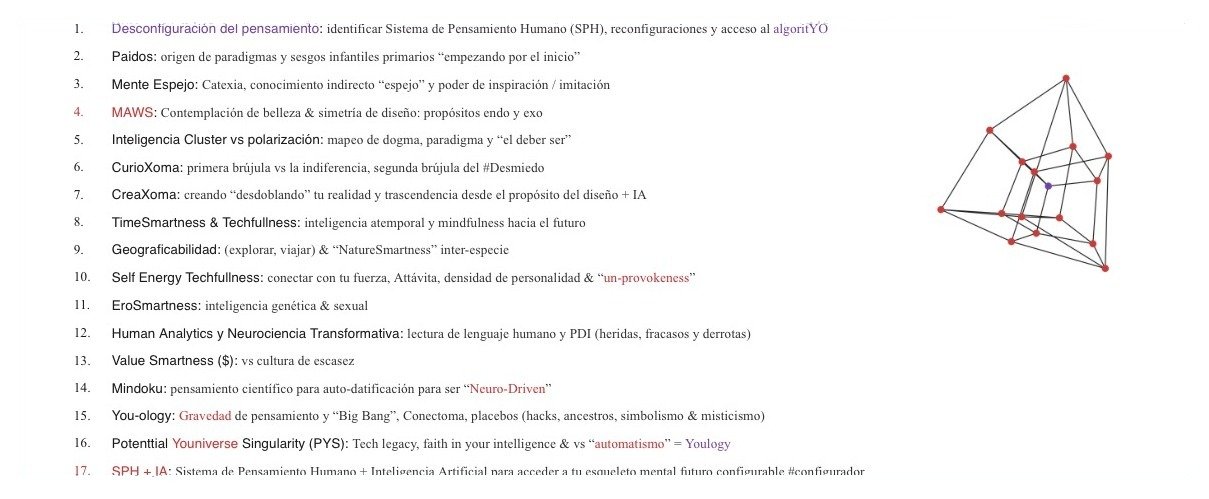
- Thought deconfiguration: identifying the Human Thinking System (HTS), its reconfigurations and access to the algorithMe.
- Paidos: the origin of paradigms and primary childhood biases, “starting at the beginning”.
- Mirror Mind: cathexis, indirect “mirror” knowledge and the power of inspiration and imitation.
- MAWS: contemplation of beauty and design symmetry: endo and exo purposes.
- Cluster Intelligence vs polarization: mapping dogma, paradigm and “what should be”.
- CurioXoma: first compass against indifference, second compass of #Desmiedo.
- CreaXoma: creating by “unfolding” your reality and transcendence from the purpose of design + AI.
- TimeSmartness & Techfullness: timeless intelligence and mindfulness toward the future.
- Geograficability: exploring, traveling and inter-species “NatureSmartness”.
- Self Energy Techfullness: connecting with your strength, Attávita, personality density and “un-provokeness”.
- EroSmartness: genetic and sexual intelligence.
- Human Analytics and Transformative Neuroscience: reading human language and PDI (wounds, failures and defeats).
- Value Smartness ($): against the culture of scarcity.
- Mindoku: scientific thinking for self-datafication, to become “Neuro-Driven”.
- You-ology: gravity of thought and the “Big Bang”, Connectome, placebos (hacks, ancestors, symbolism and mysticism).
- Potenttial Youniverse Singularity (PYS): tech legacy, faith in your intelligence and against “automatism” = Youlogy.
- HTS + AI: Human Thinking System + Artificial Intelligence to access your configurable future mental skeleton. #configurador
Two subtopics connect directly with the BTS: CreaXoma, which proposes creating by unfolding reality from the purpose of design, and Geograficability, which includes inter-species “NatureSmartness”: learning from the intelligence of other species.
Thinking is technology
In its strictest sense, Thinktech means understanding and recognizing that thinking is technology: a tool that can be observed, understood and improved. Artificial intelligence forces us to ask how a machine thinks; Thinktech uses that same question to look at how we think.
The goal is to democratize access to epiphany. Epiphanies should not depend on luck, genius or privilege; they should be the consequence of a thinking system that knows itself.
Frequently asked questions
What is Thinktech?
Thinktech is technological metacognition to observe thinking systems. It is the method of Engel Fonseca, founder of N3 Labs, to see not just one isolated thought but the patterns, automations and ruminating thoughts of a mind, whether biological, human or artificial.
What is the difference between metacognition and Thinktech?
Metacognition is the ability to observe one of your own thoughts. Thinktech is the pursuit of observing the mind at its fullest possible capacity: the whole thinking system, supported by technology and artificial intelligence.
What are BTS, HTS and ATS?
They are the three thinking systems Thinktech observes: the Biological or naturalistic Thinking System (BTS), the Human Thinking System (HTS) and the Artificial Thinking System (ATS) of artificial intelligence.
Is intelligence exclusive to humans?
No. In Thinktech, life is intelligence: nature solves problems with its own Biological Thinking System (BTS). That is why Engel Fonseca argues that many human innovations are not inventions but discoveries and adaptations of solutions nature already had.
What are the 12 thought types?
Thinktech, metacognitive, spontaneous, divergent, automatic, epiphanic, interoceptive (feeling), rumination, intrusive or fear, preconscious, fixed idea and crisis. Each one is paired with a type of lightning so it is easy to remember.
Are feelings and emotions also thoughts?
In Thinktech, a feeling is a thought you feel in your body. According to neuroanatomist Jill Bolte Taylor, an emotion runs through the body in about 90 seconds; when it lasts longer, a thought keeps feeding it and it turns into a feeling.
Why observe thinking systems?
To grow in self-knowledge, understand where a thought comes from before judging it, and decide whether to inhibit or boost it. Observing the system shows that erratic behaviors are not phenomena but consequences, and that cognitive assertiveness is not luck either.
Start observing your thinking system
The first step is the HTS Map (Mapa SPH), the test to see your Human Thinking System. Coming soon are two new ThinkIAs: one to see your cognitive tree and another, under construction, on thought lightning, to identify which type of lightning each of your thoughts is.
Observe your own storm
Take the HTS Map at n3.potenttial.com/mapa-sph →
Measure your curiosity with the Curioxoma Test →
Book a keynote on Thinktech →
ABOUT THE AUTHOR
Engel Fonseca is an entrepreneur, technology leader and cognitive neuroscientist. He created Thinktech, the technological metacognition method, and Curioxoma. He is the founder of N3 Labs (Thinktech IA Laboratory) and of the agency MediaScience, and CEO of Potenttial Group, a digital transformation consultancy with offices in Mexico, Miami and San Francisco. He is a partner at the Advanced Neuroscience Center (Centro de Neurociencias Avanzadas) at Hospital Ángeles del Pedregal.
He brings more than 20 years of technology innovation and over 10 years working with artificial intelligence. He was the AI representative of the “IA para todo México” program with Microsoft and CompuEducación, which trained more than 80,000 people. He is a Prosci-certified Change Practitioner and a TEDx speaker.
As a keynote speaker, he brings artificial intelligence and cognitive neuroscience to senior leadership across Latin America and the US Hispanic market.
Sources: Flavell, J. H. (1979). “Metacognition and cognitive monitoring: A new area of cognitive-developmental inquiry”. American Psychologist, 34(10). Tseng, J. & Poppenk, J. (2020). “Brain meta-state transitions demarcate thoughts across task contexts exposing the mental noise of trait neuroticism”. Nature Communications, 11. Bolte Taylor, J. (2008). My Stroke of Insight. Viking. Lightning types: NOAA/National Weather Service and Royal Meteorological Society. Thinktech, the 12 thought types classification, BTS, HTS, ATS and Curioxoma are frameworks developed by Engel Fonseca at N3 Labs.