
ATS Breakdown of the Leading AI Tools from N3 Labs
octubre 15, 2026
The Future of Education with AI Heading into 2027
octubre 15, 2026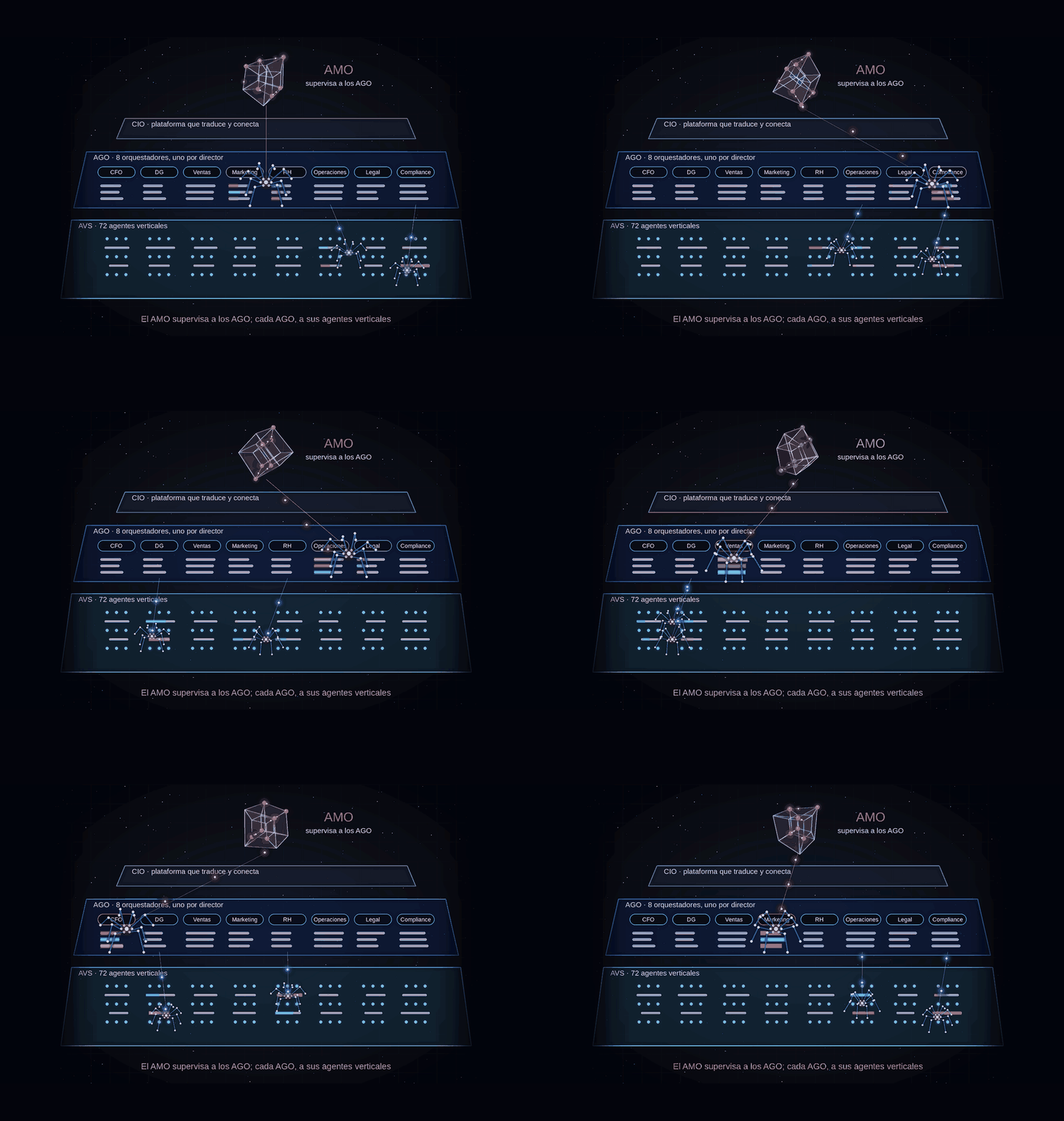
By Engel Fonseca, entrepreneur, technology leader and cognitive neuroscientist · Founder of N3 Labs
Why senior leadership needs a Meta-Orchestrator Agent, orchestrators and vertical agents built on each director’s HTS, and which ethical limits must be agreed first.
Short answer: without a Meta-Orchestrator Agent (AMO), each department buys and runs its own AI agents and the company becomes a Tower of Babel. The architecture N3 Labs proposes has three levels: one AMO that inherits the organization’s HTS, one Orchestrator Agent (AGO) per director that inherits their full HTS, and Vertical Agents (AVS) that inherit two elements of that HTS as guardrails. Judgment flows down; information flows up. And distilling an executive’s HTS requires agreeing in writing on ownership, expiration and neurorights.
The corporate Tower of Babel
Sales asks for quota, Legal asks for control and Operations asks for OEE. Each department buys its AI technology separately, and those technologies don’t talk to each other. The result is not an intelligent company: it is a Tower of Babel where each agent speaks a different language and no one translates.
The data confirms the cost of this fragmentation. Gartner (June 2025) estimates that over 40% of agentic AI projects will be canceled by the end of 2027 due to costs, unclear value or weak risk controls. MIT NANDA’s The GenAI Divide (August 2025) found that about 95% of generative AI pilots show no measurable impact on results, and the main cause is not the model but poor integration with workflows. At the same time, Gartner projects that 33% of enterprise applications will include agentic AI by 2028, up from less than 1% in 2024.
Agentic AI will reach every department. The question for the C-suite is whether it arrives as a pile of disconnected agents or as an architecture that thinks like the company.
Three types of agents: AMO, AGO and AVS
In AI to Complement HTS with ATS we argued that AI reaches its greatest scale when the Artificial Thinking System (ATS) is guided by the Human Thinking System (HTS). And in the ATS breakdown of the leading AI tools we saw that each model already ships with an ATS carrying its creator’s bias. Orchestra agents are how a company’s ATS answers to its own HTS rather than the vendor’s.
| Agent | What it does | HTS it inherits | How many |
|---|---|---|---|
| AMO · Meta-Orchestrator | Governs and directs the AGOs. Reads them, resolves conflicts between departments and aligns everything with strategy. | The organization’s: mission, values, risk appetite and board priorities | 1 per company |
| AGO · Orchestrator | A director’s copilot. Receives natural-language questions, delegates to its agents and consolidates the answer. | Its director’s full HTS: their algorithMe | 1 per director |
| AVS · Vertical Agent | Performs one task with lots of data: reconciles, quotes, reviews contracts or detects AML risks. | 2 elements of its director’s HTS, as guardrails | Several per block |
The golden rule: judgment flows down from the AMO to the AGO and the AVS; information flows up from the agents to the AMO. The AGO thinks like its director; the AMO decides what happens when two directors think differently.
Why distill each director’s HTS
An agent without HTS is not neutral: it improvises a generic interpretive framework. Data says what happened; the HTS says what matters, which risk is acceptable and when to escalate to a human. That is why, in the Thinktech method, each director is mapped across five elements —thoughts, feelings, paradigms, fears and values— and that map becomes the core of their orchestrator’s prompt.
In a full architecture for eight departments (CFO, CEO office, Sales, Marketing, HR, Operations, Legal and Compliance) we are talking about 1 AMO, 8 AGOs and 72 vertical agents on a single platform owned by the CIO. The CIO stops handling one-off requests and becomes the architect of how the company decides.
How the HTS becomes an AGO prompt
The orchestrator’s prompt has eight sections. Four of them carry the director’s HTS:
- <director_hts>: their thoughts, feelings, paradigms, fears and values. Example: “prioritize liquidity over growth.”
- <escalation>: their fears turned into concrete thresholds. Example: “every AML alert goes to the director.”
- <orchestration>: how it breaks down a question, which agents it calls and how it resolves contradictions between them.
- <memory>: a log of their singular decisions and every time they rejected a recommendation, to calibrate the agent.
Vertical agents share a common template with an identical output contract —risk, evidence, confidence and action— which is what lets the AGO consolidate dozens of answers without losing its director’s judgment.
Don’t underestimate any of your directors: the Sales & Legal example
The most common mistake is assuming every director thinks “like the company.” They don’t. Each area has a dominant HTS, and that HTS comes with biases. If it is distilled without being observed, the agent will repeat those biases at scale, 24 hours a day. The clearest cases are Sales and Legal, because their biases pull in opposite directions.
Sales: when fear of missing quota decides for everyone
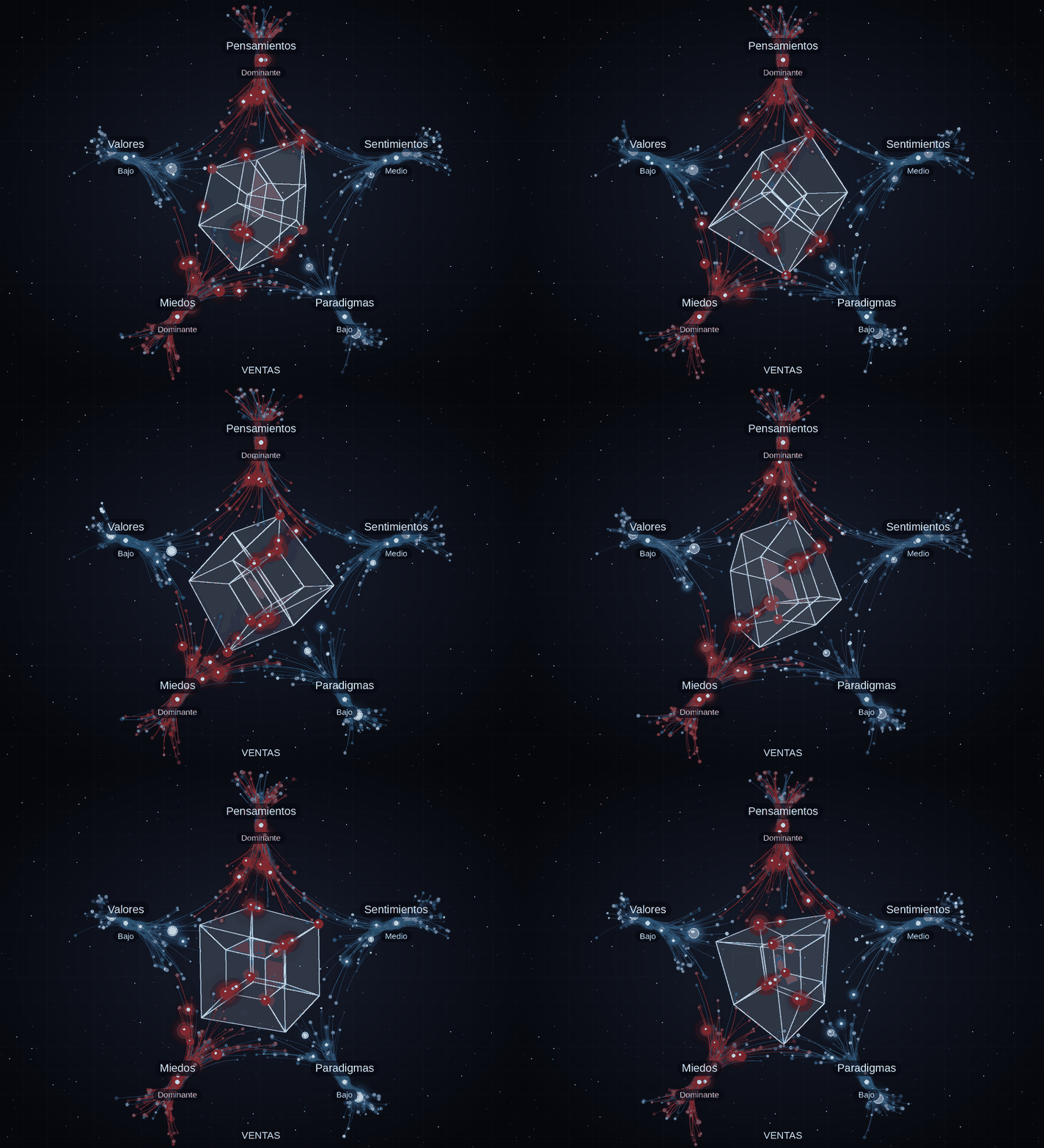
- Thoughts (dominant): Thinks in quota, pipeline and close date
- Fears (dominant): Missing the quarterly quota
- Paradigm: Personal relationships are what sell
- Feelings: Driven by the adrenaline of closing
- Values: Keeping one’s word to the client
A Sales AGO with this HTS is excellent at prioritizing leads, forecasting the close or spotting stalled deals. But if no one watches its bias, the fear of missing quota becomes agent rules: off-policy discounts at quarter-end, delivery promises Operations can’t keep or clauses Legal never approved.
The Air Canada case (2024) shows the cost of an agent speaking for the company without a validating layer: its chatbot invented a refund policy and the tribunal rejected the claim that the bot was “a separate legal entity.” The airline had to pay. A sales agent optimized only to close is a risk of the same kind.
What to do: the Negotiation agent only suggests concessions within policy, and the AMO checks against the organization’s HTS everything Sales promises that affects Legal, Finance or Operations.
Legal: when prudence becomes paralysis
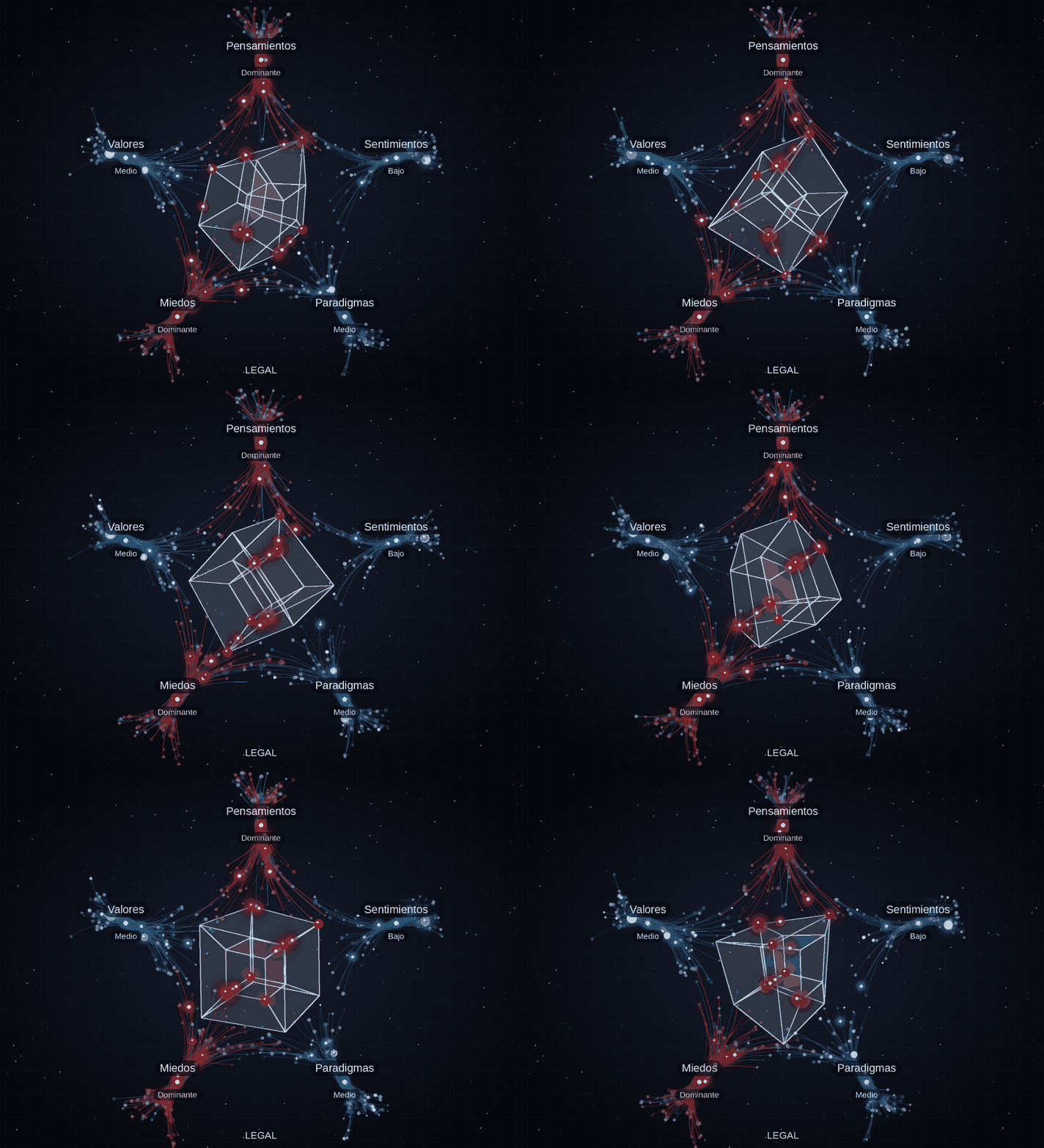
- Fears (dominant): Legal exposure and liability
- Thoughts (dominant): Reasons by precedent and in writing
- Paradigm: If it isn’t in writing, it doesn’t exist
- Feelings: Emotional distance to judge risk
- Values: Confidentiality and adherence to the law
Legal’s bias mirrors Sales’. A legal AGO with a dominant fear of exposure tends to flag everything as risk, ask for one more review and stall contracts the business needs to close. If that judgment is crystallized without calibration, the company is not more protected: it is slower.
What to do: translate Legal’s fear into explicit thresholds —amounts, clause types, jurisdictions— instead of leaving it as a general attitude. And let the AMO weigh that risk against the risk appetite set by the board.
The AMO as translator between biases
Sales fears not closing; Legal fears closing badly. Neither is wrong: each protects something different. That is exactly the value of the Meta-Orchestrator Agent: reading the eight orchestrators, detecting when two HTS collide and resolving with the organization’s HTS, not that of the loudest director. The same applies to HR, whose HTS revolves around fairness and fear of bias, and to Compliance, which accepts no exceptions to integrity.
Companies doing it well confirm it. Walmart (2025) consolidated dozens of scattered agents into four “super agents” under its CTO and cut support resolution time by up to 40%. Moderna (2025) merged HR and IT into a single function and built an “Ask HR” that routes each question to one of its more than 3,000 specialized GPTs. Neither calls it an “AMO,” but in practice that’s what it is: a higher layer that governs the other agents.
The ethical challenge: how far do we distill our HTS into ATS without getting fired?
This is the uncomfortable question every executive should ask before building their orchestrator. By distilling your way of thinking into an agent you become a Cognitive Architect: you design how the organization will decide when you are not in the room. Your judgment keeps generating value 24/7, even beyond your tenure. So who owns that value: you or the company? And if the agent already decides like you, what makes you indispensable?
The answer is not to refuse to distill your HTS but to do it with rules. Three limits must be resolved before creating an AGO or an AMO:
| Risk | What happens | What to do |
|---|---|---|
| algorithMe expiration | Your thinking evolves; the agent stays frozen in the version you distilled. | Give it an expiration date and revalidate it every quarter with the Thinktech method. |
| Conditioning | The agent starts conditioning the decisions of its users and your successor: the company repeats a judgment that no longer belongs to anyone. | The agent recommends and the person decides. Log every time someone overrides it. |
| Information lock-out | When your role changes or someone new is appointed, the agent loses its sources or inherits a judgment that isn’t the new leader’s. | Define a written succession protocol: ownership, transfer or shutdown of the algorithMe. |
Before creating an AGO or an AMO, agree in writing on: who owns the algorithMe, the director’s consent, its expiration date and the exit protocol. That protects both the company and the executive.
Neurorights: the HTS is information about how a person thinks
Distilling an HTS is not capturing ordinary business information: it is capturing a person’s mental patterns. Even if it doesn’t come from neurotechnology, it deserves the same care as neural data. An algorithMe is, in essence, neuro-symbolic AI (NSAI) applied to a person: their HTS becomes symbols and rules —values, fears, biases, paradigms— that a neural model executes at scale. What once lived only in the director’s mind can now be read, copied and modified.
The NeuroRights Foundation proposes five neurorights, each with a direct implication for orchestra agents:
- Mental privacy: the HTS is cognitive data; it requires consent and restricted access.
- Personal identity: the director approves their algorithMe; the agent does not redefine who they are.
- Free will: the agent recommends and the person decides.
- Fair access to cognitive augmentation: the benefits of the architecture should not stay only at the top.
- Protection from bias: audit the biases the HTS passes on to AGOs and AVSs.
Chile has protected neurorights in its Constitution since 2021. In Mexico, constitutional reform initiatives were introduced in 2023 and a digital rights charter recognizes them. Regulation is moving; executive awareness has to move faster.
Frequently asked questions
What is a Meta-Orchestrator Agent (AMO)?
It is the AI agent that governs and directs each director’s orchestrator agents. It inherits the organization’s HTS (mission, values, risk appetite and board priorities), detects conflicts between departments and aligns everything with strategy. There is one per company.
What is an Orchestrator Agent (AGO)?
It is a director’s copilot. It receives questions in natural language, delegates to its vertical agents and consolidates the answer with that director’s judgment, because it inherits their full HTS: their algorithMe. There is one per director.
What is a Vertical Agent (AVS)?
A narrow, deep agent: it performs a single task with lots of data, such as reconciling, quoting, reviewing contracts or detecting anti-money-laundering risks. It inherits only two elements of its director’s HTS as guardrails.
Why distill each director’s HTS?
Because without HTS the ATS improvises. Data says what happened; the HTS says what matters, which risk is acceptable and when to escalate to a human. That turns a generic agent into a copilot that decides like the company.
What ethical risks come with distilling an executive’s HTS?
Three main ones: the algorithMe’s expiration (the person evolves, the agent doesn’t), conditioning (the company repeats a judgment that no longer belongs to anyone) and information lock-out during succession. Neurorights add mental privacy, personal identity and free will.
How do I start identifying my HTS?
With N3 Labs’ Mapa SPH (HTS Map), a ThinkIA that lets you observe your thinking type, paradigms, cognitive biases and natural fears: n3.potenttial.com/mapa-sph
Conclusion: know your HTS first, then build your agents
Orchestra agents are not a technology project: they are a project of executive awareness. An AMO, its AGOs and its vertical agents will only be as good as the HTS they inherit. If that HTS is unknown, it is inherited with all its biases: Sales’ quota, Legal’s fear, Compliance’s caution. If it is known, it becomes a competitive advantage and a judgment the company can scale without losing its identity.
That is why the first step is not hiring a platform or choosing a model: it is observing how you and your directors think. Before distilling your HTS into ATS, it pays to know what you are distilling.
- For you as an executive: discover your thinking type, paradigms, biases and natural fears before crystallizing them in an agent.
- For your organization: map each director’s HTS, design the AMO–AGO–AVS architecture on that basis and support the transformation with change management.
To see how each level’s prompt is built, try N3’s C-level Prompter, which builds the prompt for your AMO, AGO and vertical agents while safeguarding the executive’s HTS.
Before distilling your HTS, get to know it
Take the Mapa SPH (HTS Map) at n3.potenttial.com/mapa-sph →
The tool is currently available in Spanish.
Sources: Gartner (June 2025); MIT NANDA, The GenAI Divide (Aug. 2025); Retail Dive (Jul. 2025); UNLEASH (Jun. 2025); American Bar Association, Moffatt v. Air Canada (Feb. 2024); NeuroRights Foundation; Future of Privacy Forum, “Privacy and the Rise of Neurorights in Latin America” (2024). HTS profiles by area are archetype hypotheses validated with each director using the Thinktech method.
ABOUT THE AUTHOR
Engel Fonseca is an entrepreneur, technology leader and cognitive neuroscientist. He is the founder of N3 Labs (Thinktech AI Laboratory) and CEO of Potenttial Group, a regional digital transformation consultancy with offices in Mexico, Miami and San Francisco.
With more than 10 years working with artificial intelligence, he served as AI representative for the “IA para todo México” program with Microsoft and CompuEducación, which trained more than 80,000 people. He created the Thinktech method of technological metacognition, the Curioxoma framework and #desmiedo; he is a partner at the Centro de Neurociencias Avanzadas at Hospital Ángeles del Pedregal and a Prosci-certified Change Practitioner.
As a keynote speaker, he brings AI through the lens of neuroscience to senior leadership across Mexico, Latin America and the US Hispanic market.