
Google Ads en crisis por las búsquedas sin clic y conversaciones en IAs
octubre 28, 2026
GlobalLogic lanza Test Automation Kit con IA agéntica
octubre 28, 2026
By Engel Fonseca, entrepreneur, technology leader and cognitive neuroscientist · Founder of N3 Labs
Short answer: Google is not losing money: its search revenue grew 17% in Q2 2026, to $63.3 billion. What is in crisis is what Google Ads sold advertisers for 20 years: paying for a click to their own site. When Google shows an AI summary, paid-ad CTR fell 68% between June 2024 and September 2025 (Seer Interactive). Users no longer search for results: they search for conversations, across several AIs at once. Inside a conversation, a brand only exists if the AI cites it. That is GEO.
Key definitions
Zero-click (clickless) search: a search that ends without the user visiting any site, because the answer already appears in Google or in the AI.
GEO (Generative Engine Optimization): the discipline of getting AI to cite, mention and recommend a brand inside the answer. It is the atomized evolution of SEO.
Conversational Privacy Sense (CPS): the perception that staying in a conversation with an AI that researches several sources feels more personal than visiting a brand’s site and its self-centered content.
Artificial Thinking System (ATS): the way an AI prioritizes, filters, processes and reacts to information, including the user’s previous conversations.
Creaxoma: my framework that AI is something (ΔO) simulating someone (ΔN): we do not create, we discover.
Google before and after AI: what N3 Labs measures
In seven years, zero-click search went from half of all searches to two out of three. The N3 Labs research team put the data together in this chart:
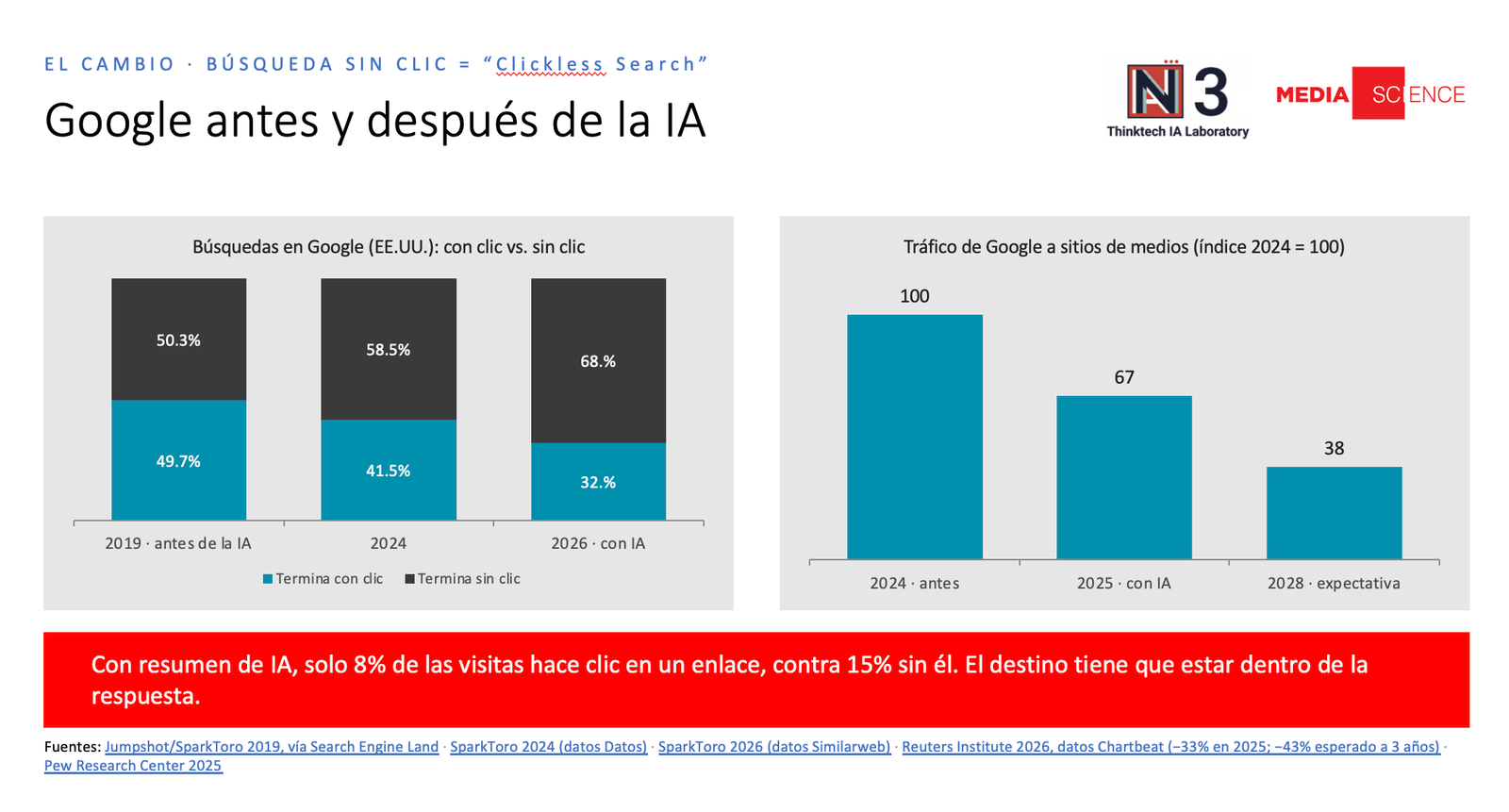
- Zero-click: 50.3% of US Google searches ended without a click in 2019; 58.5% in 2024 and 68% in 2026.
- Media: Google traffic to media sites fell 33% in 2025, and publishers expect a 43% drop over three years.
- AI summary: when one appears, only 8% of visits click a link, versus 15% when it does not.
Paid ads are losing the click too
The hit is not only organic. Seer Interactive measured 3,119 informational queries across 42 brands from June 2024 to September 2025:
| Google search (Q3 2025) | Paid-ad CTR | Year-over-year change |
|---|---|---|
| No AI summary | 13.88% | −20.1% |
| AI summary that cites the brand | 7.89% | −53.9% |
| AI summary that does not cite the brand | 4.14% | −78.4% |
The key is in the last two rows: when AI cites the brand, its ad gets almost twice the clicks it gets when AI does not. Being inside the answer now decides how well what you pay for outside it performs.
Google knows it and is moving the ad into the conversation: in AI Mode, which already has more than one billion monthly users, it is testing formats such as Highlighted Answers and Direct Offers, sponsored links inside the answer. The crisis is not Google’s. It belongs to the advertiser still buying clicks from users who no longer click.
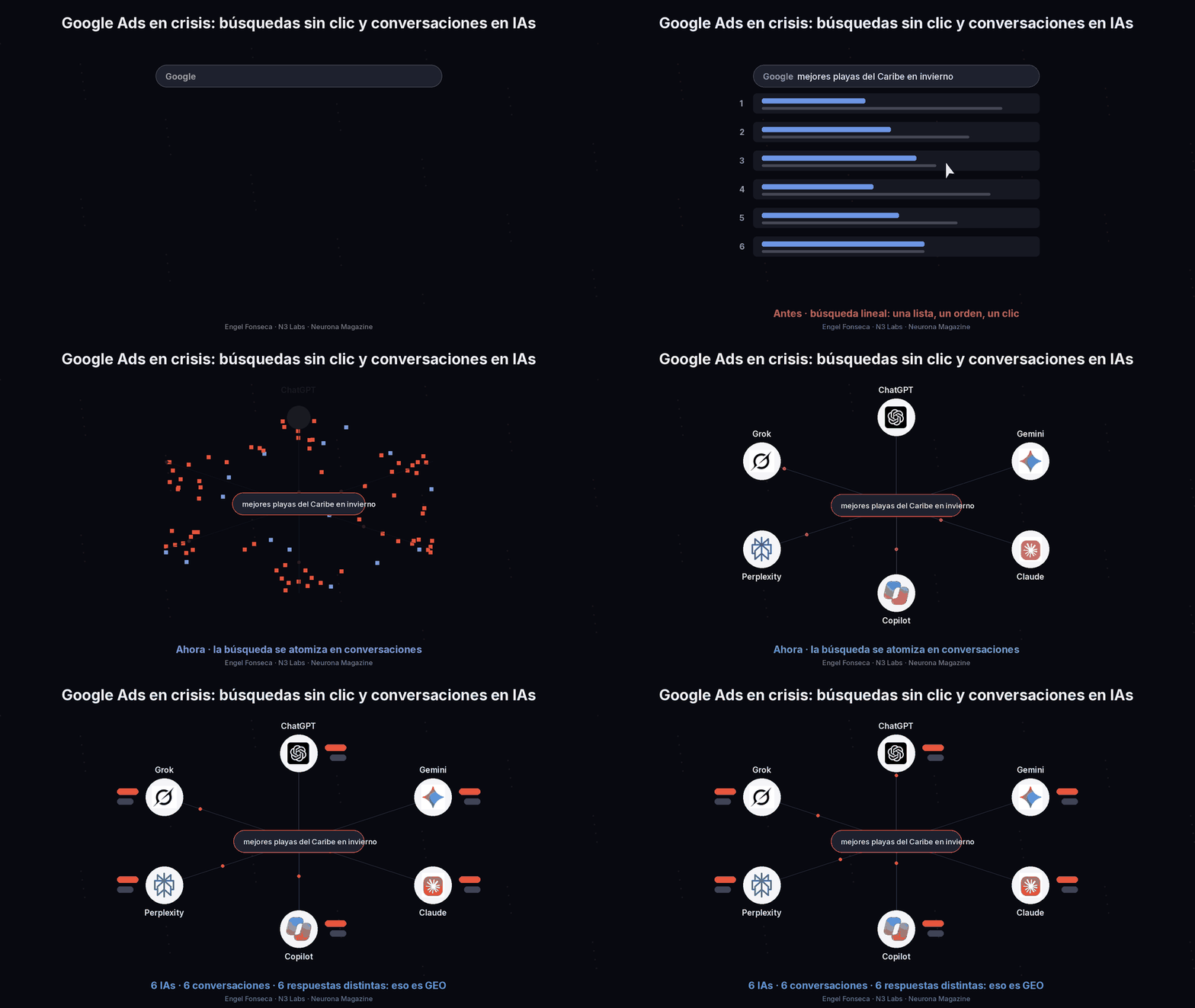
From searching results to searching conversations
Users did not stop clicking out of laziness. They changed the way they search for three reasons rooted in how they think, not only in technology.
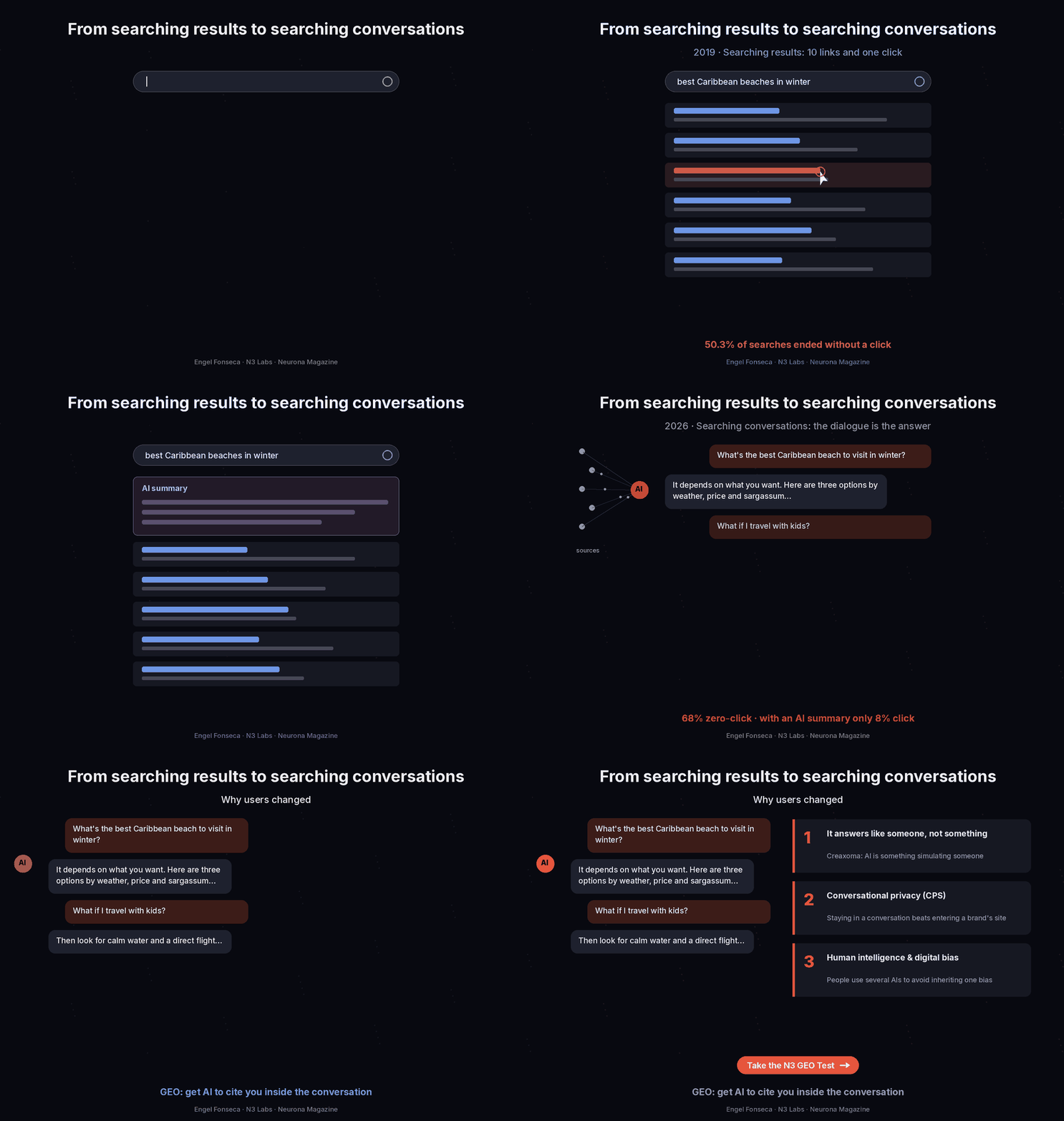
1. Technology started answering like someone, not something
In my Creaxoma framework, AI is something (ΔO) that simulates someone (ΔN). For 25 years the search engine answered like something: a list of links. Generative AI answers like someone: it understands the question, asks back and remembers the context.
You don’t leave someone who is talking to you with a click: you keep asking. That simulation turned the query into a dialogue, and the dialogue does not end on a brand’s site.
2. Conversational Privacy Sense (CPS) versus self-centered content
CPS is the perception that it feels more personal to stay in a conversation with an AI that researches several sources for you than to go out to a single source. On a brand’s site, users are exposed to its self-centered content: everything talks about the brand, nothing compares, and almost everything asks for their data.
In the conversation, users feel they are asking in private and that the AI works for them. That is why they prefer the AI to go to the sources instead of visiting each one themselves.
3. Human Intelligence Sense and Digital Bias
Users do not stick to a single AI either. Partly for privacy, but also because they sense that AI biases its answers based on previous conversations.
An example: if you tell ChatGPT about a problem with your partner and later about a problem with a client, its ATS (Artificial Thinking System) may point out that “you have a problem in general.” It may be true, but it is uncomfortable. That is why people spread their questions across ChatGPT, Gemini, Claude, Copilot, Perplexity and Grok. I explain it in depth in Does an AI Carry the Bias of Its Human Creator?
For a brand, this changes the board: there is no longer one search engine to win, but several conversations, each with its own ATS.
GEO: the atomized evolution of SEO
If search is now a conversation, a brand needs GEO (Generative Engine Optimization): getting AI to cite, mention and recommend it inside the answer. I call it the atomized evolution of SEO because Google’s list broke into thousands of answers, across several AIs at once.
| SEO | GEO | |
|---|---|---|
| Competes for | A position on the list | Being cited inside the answer |
| Where | ChatGPT, Gemini, Claude, Copilot, Perplexity, Grok and Google’s AI Mode | |
| Unit | The page | The citable fragment: a fact, an answer, a source |
| Measured by | Ranking and clicks | Mentions, citations and recommendations in each AI |
| Content talks about | The brand | The user’s question, with verifiable data |
Three decisions to start:
- Write to answer, not to show off. Short answer first, data with source and date, real FAQs.
- Be where AI looks. Media, directories and third-party sources AI already cites, not just your own site.
- Measure each AI separately. Each has its own ATS, and the same question gives different rankings in each.
Take the N3 GEO Test
To know where you stand, N3 Labs built the N3 GEO Test, a free tool. It analyzes your site, your brand or your name on the criteria that make content readable to AI, and estimates your visibility in ChatGPT, Gemini, Copilot, Grok, Claude and Perplexity.
Frequently asked questions
What is zero-click (clickless) search?
A search that ends without the user visiting any site, because the answer already appears in Google or in the AI. In 2026 it is 68% of US Google searches.
Will Google Ads disappear?
No. Google keeps growing and is bringing its ads into AI Mode. What is losing value is the click to the advertiser’s site.
What is Conversational Privacy Sense (CPS)?
The perception that staying in a conversation with an AI that researches several sources feels more personal than visiting a brand’s site and its self-centered content.
Why do people use several AIs?
For privacy, and because each AI biases its answers with previous conversations. Spreading questions protects the way you think.
What is the difference between SEO and GEO?
SEO seeks a position on Google’s list. GEO seeks for AI to cite and recommend the brand inside the conversation, across several AIs at once.
How do I know if AI recommends me?
With the free N3 GEO Test by N3 Labs: n3labs.potenttial.site/geotest-en.html
Sources
- Jumpshot/SparkToro 2019, via Search Engine Land
- SparkToro 2024 Zero-Click Search Study
- SparkToro 2026: less than one third of Google searches still send a click
- Press Gazette: Reuters Institute trends report 2026
- Pew Research Center 2025: AI summaries and clicks
- Seer Interactive: AIO impact on Google CTR, September 2025
- PPC Land: Google Search ads gain 17% to $63.3 billion (Q2 2026)