

Tokenómetro: agradecer a la IA una vez al día cuesta $104 MXN al año
noviembre 3, 2026
El ROI se ha quedado corto
noviembre 3, 2026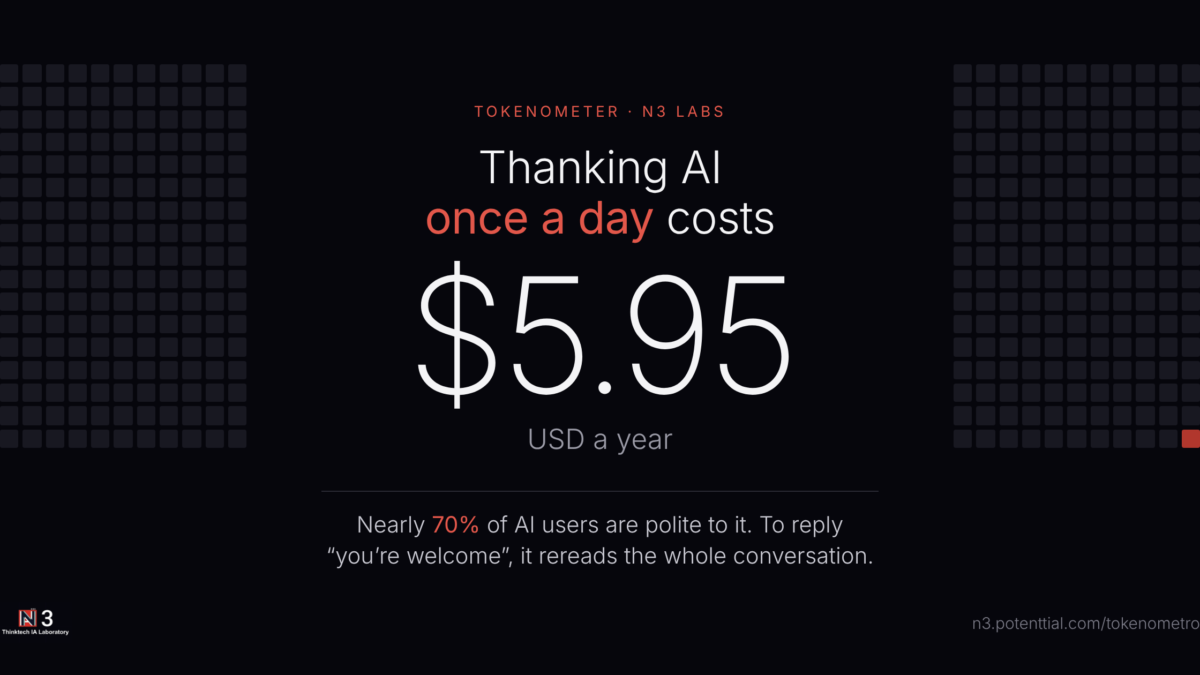
By Engel Fonseca, entrepreneur, tech leader and cognitive neuroscientist · Founder of N3 Labs
Short answer: nearly 70% of AI users are polite to it. But when you type “thank you” to an AI, you don’t pay for those two words alone. To reply “you’re welcome!”, the model rereads the entire conversation. In a work chat of about 8,000 tokens, on a model priced at 2 dollars per million input tokens, each “thank you” costs US$0.016. Once a day, that’s US$5.95 a year ($104 Mexican pesos) at API prices. The problem isn’t politeness: it’s the indifference with which we use AI. AI didn’t arrive so we could pay less attention, but so we could be more selective about investing quality attention. Measure it for free with the N3 Labs Tokenometer.
Key definitions
Token: the unit an AI splits text into in order to read and write it. It can be a whole word, part of a word, a number or a symbol. AIs bill and measure usage in tokens, not words.
Tokenometer: a free N3 Labs tool that counts tokens as you type, explains why the AI splits your text the way it does, compares the cost on ChatGPT, Gemini, Claude, Perplexity, Copilot and DeepSeek, and grades your prompt from 0 to 100. It runs in the browser and uses no tokens.
Technological awareness: knowing what resource each action you take with technology consumes, so you can decide where it is worth investing.
Thinktech: technological metacognition for observing thinking systems. It starts from one premise: thinking is technology.
Curioxoma: professionalized, sustained curiosity, the antidote to indifference.
The math: why a “thank you” costs US$5.95 a year
An AI has no memory between messages. Every time you write something, the system sends it the whole conversation again: your instructions, the documents you pasted and every previous answer. Those are input tokens. Then the model writes its reply, the output tokens, which cost several times more.
That’s why the words “thank you” barely weigh anything: one or two tokens. What weighs is the reread. A “thank you” at the end of a long chat costs almost as much as a new question.
| One “thank you” a day | Model (USD per million tokens, input / output) | Cost per “thank you” | Per year |
|---|---|---|---|
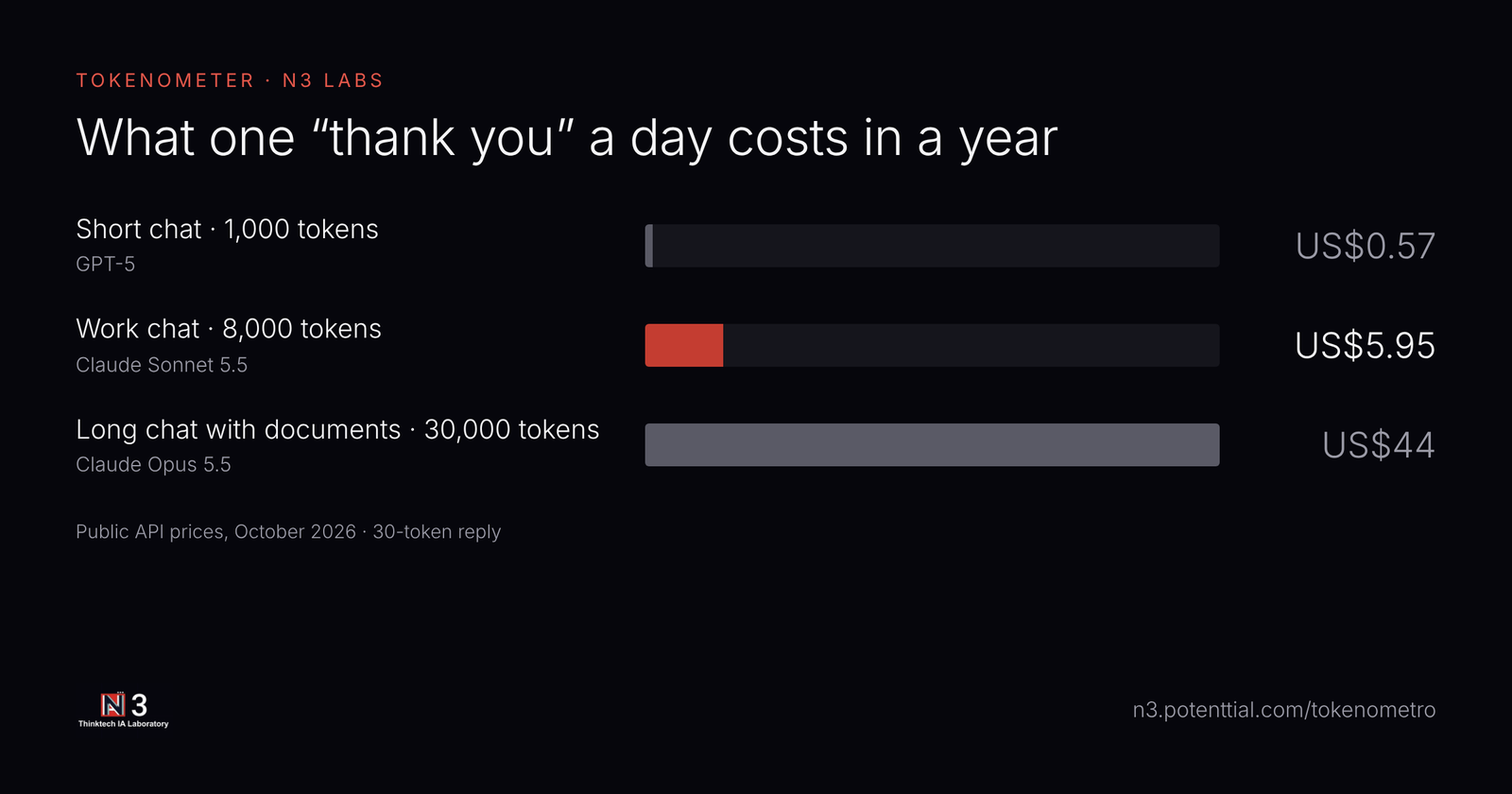
| Short chat · 1,000 tokens | GPT-5 · $1.25 / $10 | US$0.0016 | US$0.57 |
| Work chat · 8,000 tokens | Claude Sonnet 5.5 · $2 / $10 | US$0.016 | US$5.95 |
| Long chat with documents · 30,000 tokens | Claude Opus 5.5 · $4 / $20 | US$0.12 | US$44 |
Assumptions: a 30-token reply (“You’re welcome! Anything else?”), 365 days, public API prices as of October 2026. Some platforms reuse part of the history through caching and charge less for it; without caching, this is the math.
If you pay for a subscription, you don’t see this charge, but it doesn’t disappear: every reread uses up your plan’s allowance, and someone pays for it. In a company that connects AI to its systems, it does show up on the bill: 1,400 employees saying thank you once a day, Monday to Friday, in a work chat add up to about US$5,900 a year.
What does it cost your company?
Yearly cost of every employee thanking AI once a day, over 260 working days (Monday to Friday) at API prices:
| Employees | Short chat · 1,000 tokens | Work chat · 8,000 tokens | Long chat · 30,000 tokens |
|---|---|---|---|
| 100 | $40 USD | $424 USD | $3,136 USD |
| 250 | $101 USD | $1,060 USD | $7,839 USD |
| 1,400 | $564 USD | $5,933 USD | $43,898 USD |
Calculate the cost for your company
Change the values and see what a “thank you” costs at the scale of your team.
Cost per year
—
— per employee
— tokens reread a year
Write the “thank you” inside your next useful prompt and this cost disappears.
How much do companies spend on AI per employee?
In the United States, the average company spends US$2,068 a year per employee on AI in 2026, 50% more than in 2025, according to Federal Reserve Bank of Atlanta data compiled by Rize. The average hides a wide spread: the median company spends less than 200 dollars, and the top 10% at least 2,800.
Standard commercial licenses such as Microsoft Copilot, Claude Team or Cursor cost 20 to 30 dollars a month per user: US$240 to US$360 a year. At API prices, a single daily “thank you” equals almost 2% of what a 20-dollar license costs. That share doesn't show up on the bill, but it uses up the allowance the company already paid for.
What Sam Altman said
In April 2025, someone on X asked OpenAI's CEO how much money the company loses in electricity because people type “please” and “thank you”. He answered: “tens of millions of dollars well spent—you never know”. And it isn't an isolated case: nearly 70% of people who use artificial intelligence (such as ChatGPT or Gemini) tend to be polite: they greet it, say please or say thank you, according to El Confidencial (February 2025, in Spanish). A Future survey from the same year puts it at 67% of users in the United States.
I'm not writing this so you stop saying thank you. I'm writing it because that figure shows something more important: millions of people use AI without knowing what each message consumes. That has a name.
The problem isn't politeness, it's indifference
In my article Indifference is your brand's number one enemy (in Spanish) I explain that indifference is the absence of attention and attachment. With AI, it shows up in habits nobody measures:
- The repetitive: one chat for everything for weeks. Every new question drags along thousands of tokens of history that no longer matters.
- The superficial: “make me something nice”. With no goal or format, the first answer misses and has to be requested three times.
- The undefined: drip-feeding the idea: “hi”, “you there?”, “let me explain”. Every message bills everything before it again.
- Generalizing: using the most expensive model to fix spelling, because “all AIs are the same”.
The antidote is the same one I propose for brands: Curioxoma, professionalized curiosity. Asking yourself what you are requesting, why, and what it costs to request it is curiosity applied to how you use technology.
A vague prompt produces slop
In Digital entropy: slop and enshittification (in Spanish) I describe how synthetic noise began to drown out the human signal. Slop isn't born only in content farms. It's also born at the office, every time someone asks AI for a text without saying who it's for, what it's for or how long it should be.
The result is workslop: long answers that have to be read, fixed and requested again. You pay twice: in tokens and in human attention. The indifference behind the prompt turns into entropy inside the company.
AI is not for paying less attention
There's a dangerous idea going around: that AI is for thinking less. It's the opposite. AI didn't arrive so we could pay less attention, but so we could be more selective about investing it. You delegate the repetitive work to focus your quality attention on what only you can decide.
The first principle of Thinktech (in Spanish) says your attention is your energy. Tokens are the AI's energy. A good prompt is where both energies meet without waste: your attention decides what to ask, and the AI spends only what it needs to solve it.
That's why I insist that thinking is technology. Our greatest contribution in the age of AI isn't writing faster or producing more content. It's knowing how to think: being clear about the goal, the context and the criteria before asking. Whoever thinks well writes better prompts, and whoever writes better prompts spends less.
How to optimize tokens with technological awareness
A Worklytics analysis published in 2026 estimates that asking for the exact format and length cuts each task's tokens by 45% to 80%: up to 80% on meeting notes, 60–70% on summaries and 50–65% on emails. Five habits to get there:
- One complete message. Context, task, format and limits together. No “I'll send more info in a moment”.
- Set a cap. “100 words max” or “5 bullets”. Output is the most expensive part.
- One chat per topic. Start a new one when you change subjects.
- The right-sized model. A light one to summarize or translate; the expensive one to analyze and decide.
- Say thanks inside your next prompt. “Thanks, now turn it into a table” costs the same as the request alone and keeps the courtesy.
In companies, the shortcut is using prompters: tested templates that build the right prompt from the first message. At N3 Labs we built the N3 Prompter, the CFO Prompter and the C-level Prompter for senior leadership.
Measure your prompt with the Tokenometer
The Tokenometer shows in real time how AI splits your text, why one word costs more than another and what you would pay for that text on each model, in US dollars or any Latin American currency. It also grades your prompt from 0 to 100 and hands you an optimized version. It's available in English, Spanish and Portuguese, and it uses no tokens.
Keynotes and courses
I give keynotes and courses for companies on AI from neuroscience: Thinktech, Curioxoma against indifference, technological awareness and efficient use of AI in teams. To bring them to your company or event, message me on WhatsApp at +52 55 2905 0452.
Frequently asked questions
How much does it cost to say “thank you” to ChatGPT?
It depends on the length of the conversation and the model. In a work chat of about 8,000 tokens, on a model priced at 2 dollars per million input tokens, each “thank you” costs about US$0.016: US$5.95 a year if you say it once a day.
How much do companies spend on AI per employee?
In the United States, the average company spends US$2,068 a year per employee on AI in 2026, according to Federal Reserve Bank of Atlanta data compiled by Rize. A standard commercial license costs 20 to 30 dollars a month per user.
How many people say thank you to AI?
Nearly 70% of people who use artificial intelligence (such as ChatGPT or Gemini) tend to be polite: they greet it, say please or say thank you, according to El Confidencial (February 2025).
Why does a short message cost so much?
Because the AI rereads the whole conversation before answering. The cost depends on the history, not on the length of your message.
Should I stop being polite to AI?
No. Say thanks inside your next useful prompt, for example: “Thanks, now summarize it in 5 bullets”. You keep the courtesy and don't pay for an extra reread.
How much can a company save with better prompts?
Between 45% and 80% of tokens per task when it asks for the exact format and length, according to Worklytics (2026).
What is the Tokenometer?
A free N3 Labs tool that counts tokens in real time, compares costs across six AIs and grades your prompt from 0 to 100. It lives at n3.potenttial.com/tokenometro.
What does indifference have to do with the cost of AI?
Indifference is using AI without attention: endless chats, vague prompts and drip-fed requests. Those habits multiply tokens and produce answers that don't help.
Sources
- Rize: AI spending per employee benchmark 2026 (Federal Reserve Bank of Atlanta data)
- Entrepreneur: Sam Altman on the cost of saying “please” and “thank you” (April 2025)
- TechRadar: tens of millions of dollars on “please” and “thank you”
- El Confidencial: saying please and thank you to AI (February 2025, in Spanish)
- Worklytics: How can employees lower the cost of their LLM usage (2026)
- N3 Labs Tokenometer: API prices by model, October 2026