

Solo el 11% de las empresas configuran el futuro desde el presente con la IA
noviembre 27, 2026
Evolución digital empresarial en México
noviembre 27, 2026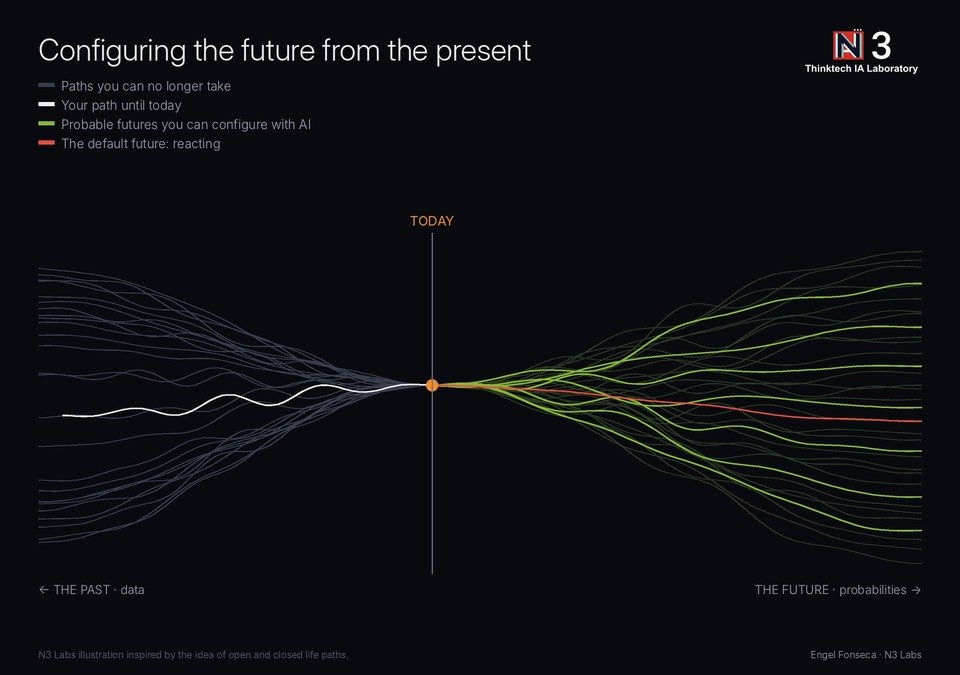
By Engel Fonseca, entrepreneur, technology leader and cognitive neuroscientist · Founder of N3 Labs
Short answer: according to the “Marketing Digital en América Latina 2026” study by NTT DATA and IAB México, 69% of companies use AI to generate content and design, but only 11% use it for predictive models and 12% for sales forecasting. We are using AI to solve the present, not to configure the future. And the essence of intelligence is prevention, not reaction, because in reaction there is no choice.
What the IAB México and NTT DATA study says
On November 24, 2026, NTT DATA and IAB México, together with Tecnológico de Monterrey and IAB chapters across Latin America, presented the study “Marketing Digital en América Latina 2026” (Digital Marketing in Latin America 2026). It analyzed more than 700 brands and institutions in 10 countries; 84.9% are companies with more than 250 employees.
When the study asks what they use AI for, the answer is clear:

| AI use | Companies | Type |
|---|---|---|
| Content generation and assisted design | 69% | Productivity and automation |
| Conversational marketing (chatbots) | 45% | Productivity and automation |
| Social listening and sentiment analysis | 26% | Productivity and automation |
| Real-time personalization and automated nurturing | 16% | Strategic and predictive |
| Sales forecasting | 12% | Strategic and predictive |
| Predictive models | 11% | Strategic and predictive |
The same pattern shows up in measurement: 47.1% evaluate their effectiveness with tactical channel metrics, and only 7.1% translate digital impact into financial metrics such as EBITDA or market share.
I invite you to download the full “Marketing Digital en América Latina 2026” study from IAB México’s website to explore it in depth.
We are using AI for the present, not for the future
AI is being used far more for tactical and productivity tasks than for foresight: the ability to see probable futures through hard data. What this shows is that we are only thinking about the present and solving present problems, but we are not preventing future ones.
Note: starting with current problems is not bad at all. In fact, it is the best way to start implementing AI. The problem is staying there. Not using the predictability AI gives us shows that our concept of AI is heavily biased toward automation and toward doing sophisticated things faster.
We associate AI with tactics, not with strategy
There is something else this hard data shows. The fact that we do not associate AI with configuring probable futures reveals that we associate it far more with tactics than with strategy. We see it as a tool to execute today better, not as an ally to decide where to go tomorrow. And strategy is, precisely, choosing a future.
Curing or “pre-curing”?
What can contribute more to humanity and to our species: trying to heal once we are already sick, or trying to avoid getting sick before it happens? What in health we could call pre-curing.
Companies work the same way. Using AI only to produce faster is curing. Using it to see probable futures and act ahead of time is pre-curing.
The essence of intelligence is prevention, not reaction
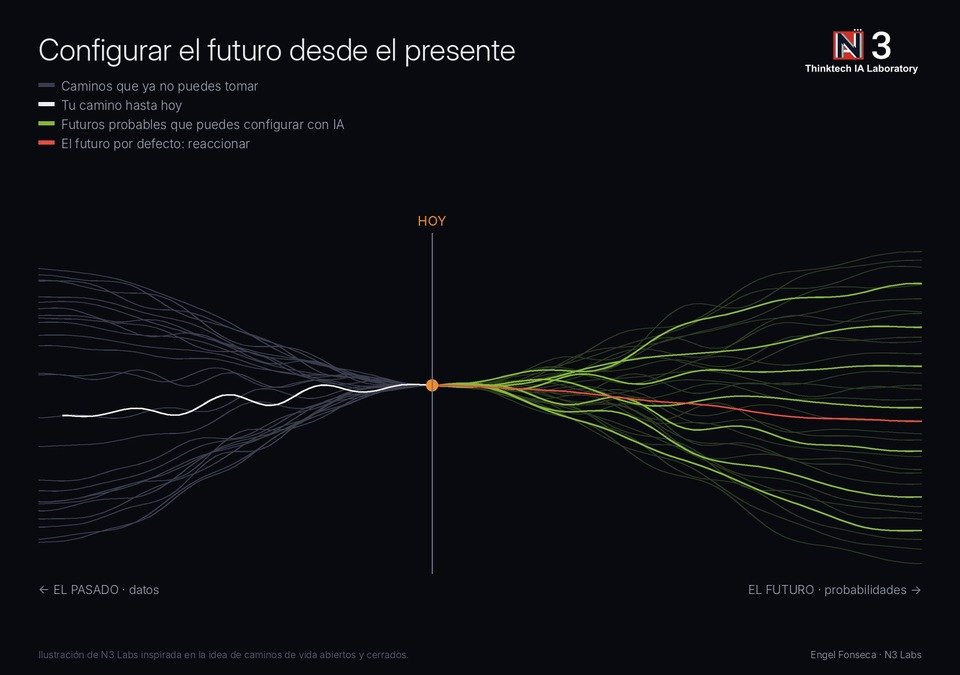
In reaction there is no choice. When the problem has already arrived, all that is left is to respond. When you anticipate it, you can choose. That is why, for me, intelligence is being able to configure the future from the present.
What is happening inside companies?
Few people are sitting down to think about probable futures. Instead, many companies bet on factors they cannot control: luck, macroeconomic factors or what happens at the country level.
I see it as a symptom: many companies are in survival mode. Thinking about a future to configure requires connecting with the present without being overstimulated and without worrying only about current operations. When all your attention goes to putting out fires, there is no attention left to imagine the future.
Data is not intelligence yet
AI can process hard data like never before, but data is not intelligence yet. Turning data into intelligence requires building meaning: understanding what it represents, what it says about us and which futures it makes probable. I have explained this before when writing about Thinktech and the deep study of meaning.
What we do at N3 Labs
This is exactly what we are doing at N3 Labs, our AI laboratory: we seek to configure probable futures from the present. We use AI to automate and be more productive, yes, but above all to see what is coming and decide today which future to build.
Personally, that is my concept of intelligence: being able to configure the future from the present.
Frequently asked questions
What percentage of companies use AI to predict the future?
According to the “Marketing Digital en América Latina 2026” study by NTT DATA and IAB México, covering more than 700 brands in 10 countries, only 11% use predictive models and 12% use AI for sales forecasting, versus 69% that use it for content generation and design.
What do companies in Latin America use AI for the most?
Mostly productivity and automation: content generation and assisted design (69%), conversational marketing with chatbots (45%) and social listening (26%). Strategic and predictive uses stay between 11% and 16%.
What does configuring the future from the present mean?
For Engel Fonseca it is the essence of intelligence: using data and AI to see probable futures and decide today which one to build, instead of reacting once the problem has arrived. In reaction there is no choice.
What is “pre-curing”?
It is taking care of yourself before you get sick. Applied to companies, it means using AI’s predictability to prevent future problems, not just to solve current ones.
Is data intelligence?
Not yet. To turn data into intelligence you have to build meaning: understand what it represents and which futures it makes probable.
Configure your future from the present
Meet N3 Labs, Thinktech IA Laboratory →
Book a keynote →
Key definitions
Foresight: the ability to see probable futures from hard data, in order to decide before they arrive.
Predictive models: AI models that estimate what will probably happen based on historical and current data.
Pre-curing: taking care of yourself before you get sick; in companies, preventing future problems instead of only reacting to current ones.
Configuring the future from the present: for Engel Fonseca, the essence of intelligence: using the present and data to choose and build the most probable future we want.
Source: NTT DATA and IAB México, with Tecnológico de Monterrey and IAB chapters in Argentina, Brazil, Chile, Colombia, Guatemala, Peru and Uruguay, “Marketing Digital en América Latina 2026”, presented on November 24, 2026 (via Quadratín). Download: iabmexico.com. Illustration and chart: N3 Labs.
ABOUT THE AUTHOR
Engel Fonseca is an entrepreneur, technology leader and cognitive neuroscientist. He created Thinktech, the technological metacognition method, and Curioxoma. He is the founder of N3 Labs (Thinktech IA Laboratory), CEO of Potenttial Group and a partner at the Advanced Neuroscience Center (Centro de Neurociencias Avanzadas) at Hospital Ángeles del Pedregal.
He brings more than 20 years of technology innovation and over 10 years working with artificial intelligence. He was the AI representative of the “IA para todo México” program with Microsoft and CompuEducación, which trained more than 85,000 people. He is a TEDx speaker and a Prosci-certified Change Practitioner.